In a 42-minute video Anthropic released on Tuesday, November 10, 2026, to market its initial public offering, chief executive Dario Amodei said cancer, Alzheimer's, heart disease, and mental illness "will be relics of the past in, I think, less than a decade." Within a day, doctors were answering him on X, and the answers were not polite.
What Amodei actually said
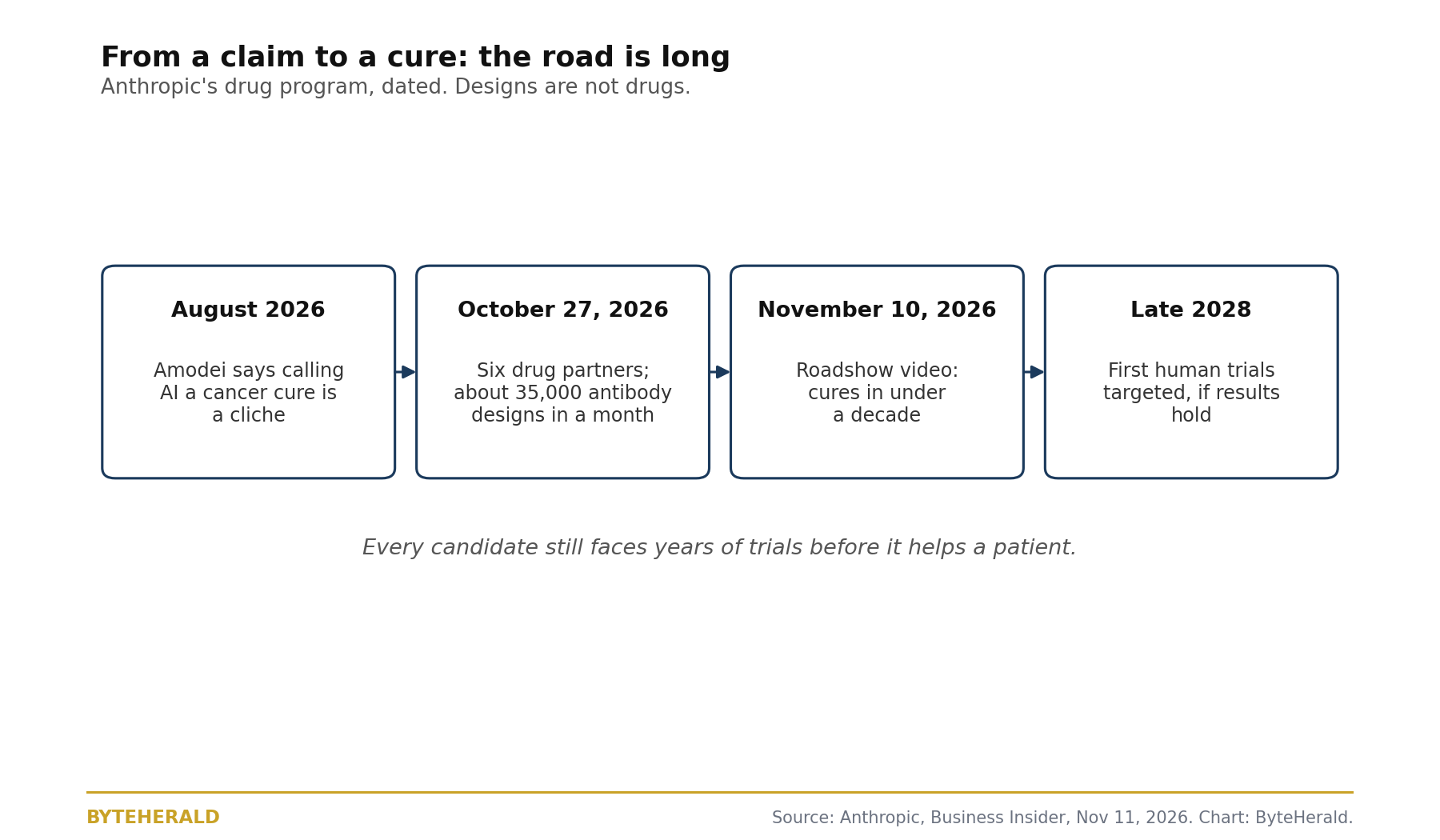
The prediction came in Anthropic's IPO roadshow video, released the same week the company filed to sell 825 million shares at 70 to 78 dollars, targeting a valuation of up to about 1.4 trillion dollars on a fully diluted basis, according to the filing we audited. Amodei told investors that if the company does its work right, "we can create an age of miracles," Business Insider reported. The cancer claim is not new for Amodei, but the setting is. In an August post on X, he wrote that the best way to win over AI skeptics is for AI companies to "actually cure cancer," while also noting that "saying that AI will cure cancer is more a cliche than it is inspiring, and most people think it is deceptive." In an IPO pitch, the calculus changed, and the cliche became the closing line.
What the doctors said
Karl Lauterbach, Germany's former health minister, wrote on X that curing cancer, Alzheimer's, and mental illnesses can definitely benefit from AI, "but that is impossible in just 10 years," and added that it was unclear whether Amodei knew little about medicine or was deliberately misleading the public, Business Insider reported. Melinda B. Chu, an AI medical researcher with an MD from Saint Louis University, said Amodei made the predictions just to stoke hype for the company's IPO, adding that "Anthropic has done nothing to suggest they themselves will contribute meaningfully to these goals." Rami Elghandour, a biotech executive who has taken two companies public, said the prediction reeks of desperation, adding: "These are insane things to say in an IPO pitch." Cardiologist Eric Topol called the prediction "severely disconnected from reality, simply impossible," according to MedXY's report of the reaction. Catharine Young, a researcher at the Harvard T.H. Chan School of Public Health, pointed to a basic biological fact: cancer is not one disease but more than 200 distinct malignant conditions, so a single cure on a single timetable is the wrong way to frame the problem.
What Anthropic's drug program has actually done
The claim is testable against Anthropic's own record. On October 27, 2026, the company announced six drug-discovery partnerships, with BigHat Biosciences, Bristol Myers Squibb, Divergence Labs, Enveda, Generate Biomedicines, and The Column Group, and said its models produced about 35,000 antibody designs in about a month for a food-allergy program, according to The Economic Times. A drug could be ready for human trials in late 2028 if more promising results are achieved, and most of the science is still preclinical, which means the candidates are not ready for clinical testing and laboratory findings do not guarantee safety or effectiveness for patients. Anthropic has also bought several biotech startups, including a one-person company focused on treatments for muscular dystrophy, and opened a wet lab in the Bay Area to explore how AI can support research in fundamental biology, Business Insider reported. We mapped the whole program in our pillar on Anthropic's drug business: six partners, no drug yet. The honest summary is 35,000 designs, zero drugs in human trials, and a first trial date more than two years away, conditional on results that do not exist yet.
Why a decade is the wrong unit
The doctors' objection is not that AI is useless in medicine. It is that finding a drug candidate is the first step of a long pipeline, not the cure. A promising design still faces laboratory experiments, animal testing, human clinical trials in three phases, and regulatory review before it reaches a patient, and each step takes years and fails most of the time. No AI-designed drug has yet reached full clinical use, a point the Free Press Journal made in its coverage of the debate. The Wall Street Journal captured the industry's mood in a headline: "Silicon Valley Promises AI Will Cure Disease. Drugmaker CEOs Aren't Buying It, Because Biology Is the Barrier." Amodei is not alone in the optimism: Google DeepMind chief Demis Hassabis has made similar projections that AI could help cure all diseases within roughly a decade. But the pattern in our audit of Anthropic's own study of AI in science, which found AI could do 27 to 52 percent of a scientist's job, is that AI accelerates the research, not the biology, and the biology is where the years go.
The test that would settle it
Amodei set his own standard in August: the way to win over skeptics is to actually cure cancer. By that standard, the roadshow claim is a promise, not evidence, and the evidence to watch is dated, not rhetorical. First, a human trial in late 2028, as Anthropic itself targets. Second, peer-reviewed results from that trial, not design counts from a press announcement. Third, a drug that reaches patients, which no AI-designed drug has yet done. Until then, the honest statement is narrower than the roadshow line: AI is speeding up the search for drug candidates, and the search is the easy part.
By ByteHerald Staff. Business Insider reported on November 11, 2026, that Anthropic chief executive Dario Amodei said in a 42-minute IPO roadshow video released on Tuesday that cancer, Alzheimer's, heart disease, and mental illness will be relics of the past in less than a decade, and that Karl Lauterbach, Germany's former health minister, replied on X that curing them is impossible in just 10 years, that Melinda B. Chu, an AI medical researcher with an MD from Saint Louis University, said the predictions were made just to stoke hype for the company's IPO, and that Rami Elghandour, a biotech executive, called them insane things to say in an IPO pitch. The Economic Times reported on November 11, 2026, that Anthropic is partnering with six companies on drug discovery, that its models produced about 35,000 antibody designs in about a month for a food-allergy program, and that a drug could be ready for human trials in late 2028 if more promising results are achieved, with most of the science still preclinical. MedXY reported on November 11, 2026, that cardiologist Eric Topol called the prediction severely disconnected from reality and simply impossible, and that Catharine Young of the Harvard T.H. Chan School of Public Health noted cancer is more than 200 distinct malignant conditions.
Comments
Post a Comment