AI political groups spent millions of dollars trying to shape the 2026 midterm elections, and in the races where the outcome was actually in doubt, most of that money lost. The clearest verdict comes from the per-race record: the most heavily backed industry candidates lost, the safety-side groups won some of their fights, and the biggest pro-industry network spent most of its general-election money on candidates who were going to win anyway. Money did not buy this Congress. It rented seats that were already safe.
The scoreboard: every major AI-money race, in one table
The table below collects the general-election and primary races TechCrunch reported on November 4, 2026, with the spender, the amount as reported, and the result. Amounts marked as reported are TechCrunch's figures, not ByteHerald's, and where TechCrunch gave no amount, the table says so rather than filling the gap. Two results need care: Scott Wiener was leading his race at publication, not declared the winner, and the table preserves that distinction; and Alex Bores lost a primary in June 2026, which is a different contest from a November general election, so his row is labeled as a primary.
| Race and candidate | AI money, as reported | Result |
|---|---|---|
| South Carolina Senate, Darline Graham | American Mission plus Building the Future, 4.8 million dollars in support | Lost |
| Montana House, Aaron Flint | American Mission, more than 500,000 dollars in support; Guardrails Alliance, more than 1 million dollars in opposition | Lost |
| North Carolina House, Laurie Buckhout | American Mission, more than 500,000 dollars in support | Lost |
| Florida House, Jared Moskowitz | Think Big, amount not reported, in support | Won reelection |
| California State Senate, Scott Wiener | Public First, 3 million dollars to a supporting PAC | Leading at publication, not yet won |
| California House, Jimmy Gomez | Guardrails Alliance, more than 1 million dollars in opposition | Lost his seat |
| California House, Angela Gonzales-Torres | Guardrails Alliance, 300,000 dollars in support | Won, defeating Gomez |
| New York 12th primary, Alex Bores | Leading the Future, 8 million dollars in opposition, June 2026 primary | Lost his bid for Congress |
Read as a scoreboard, the industry side's general-election record in this table is one win, Moskowitz, against three losses, Graham, Flint, and Buckhout, with the safety side's Guardrails Alliance winning both of its named fights, against Gomez and for Gonzales-Torres. That is a small table, and small tables mislead if they are treated as the whole election. Its value is narrower: it tests the specific claim that concentrated AI money picks winners, and on the named races, it fails that test. The wider election, including races where AI money played no reported role, is a different question, and the table does not answer it.
The safe-seat trick: 40 wins that prove nothing
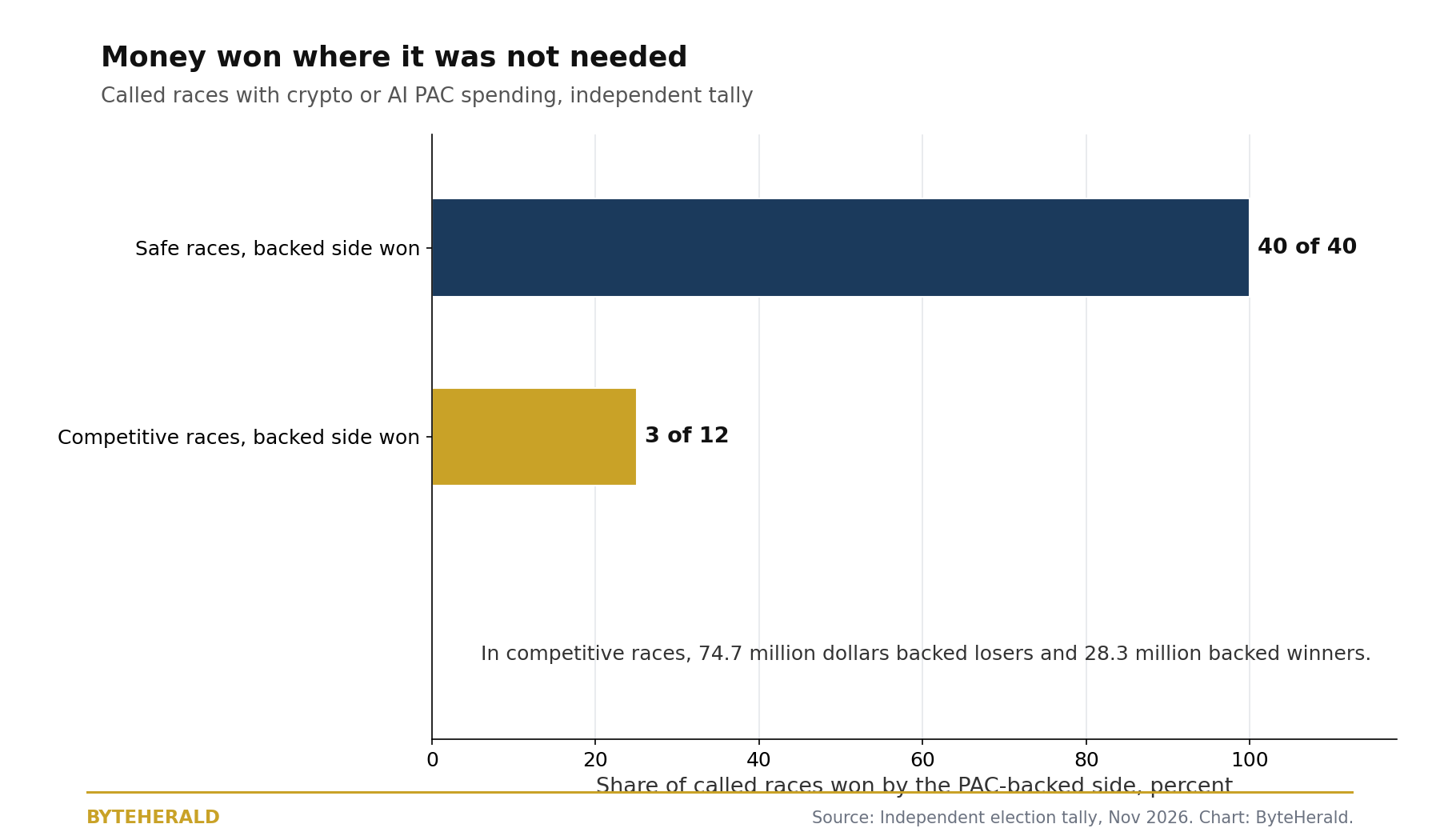
The most important number in this story is not a loss but a win total that means almost nothing. An independent election tally covering crypto and AI spending together, not AI alone, found that in the 40 safe races with such spending that had been called, the backed picks went 40 for 40. In the 12 competitive races called, the backed side lost 9 and won 3. ByteHerald arithmetic on that tally: a 100 percent record in safe races, a 25 percent record in competitive races, and 74.7 million dollars on the losing side of competitive races against 28.3 million on the winning side, a ratio of 2.64 to 1 against the spenders. The tally mixes crypto and AI money, so no AI-only share can be derived from it, and its race classifications are the tally author's, not an official category. But the shape is the point: backing safe candidates produces a win rate that looks like influence and measures nothing, because those candidates were expected to win with or without the money.
Leading the Future: 100 million in, 20 million left, little to show
Leading the Future, the biggest pro-industry network, entered the scene in August 2025 with a war chest of around 100 million dollars, backed by Andreessen Horowitz, Palantir cofounder Joe Lonsdale, and OpenAI president Greg Brockman, according to post-election analysis. It spent 27.38 million dollars in the primaries, TechCrunch reported, including 8 million dollars opposing Bores. In the general election, post-election analysis put its spending at about 10 million dollars in total, overwhelmingly behind candidates in safe races, with just over 20 million dollars still in the bank afterward and zero donations reported in the second and third quarters. Comparing the TechCrunch primary figure with the analysis general-election figure gives a ratio of about 2.74 in favor of primaries, but the two figures come from different accounts and different methods, so the ratio describes reported emphasis, not a single audited ledger.
The network's own explanation, given to TechCrunch before Election Day, is that primaries are a more effective use of money because spending there can build name recognition and help candidates set up AI policy agendas. That explanation survives the primary record only partly: Bores, the highest-profile primary target, lost his bid, and his opponent's camp argued that the spending made AI money itself the story. Guardrails Alliance political director Charlie Blaettler offered the rival theory to TechCrunch: the network spent comparatively little in competitive general-election races because it did not want its money to become an issue, pointing to a Michigan Senate primary in which a pro-Israel lobbying group spent close to 30 million dollars backing a candidate who conceded, after which the spending itself became the story. Both theories can be true at once: primaries may be cheaper influence, and visible money may also be a liability. The results do not settle which mattered more, and any article claiming they do is guessing.
What was actually at stake: one national framework, or fifty state rules
The policy fight behind the spending is concrete, and it outlives the election. TechCrunch framed it as the main dispute among AI-focused groups: whether Congress should establish a single national AI framework that overrides state laws, or whether states should maintain their own ability to impose safeguards. Leading the Future favors the national framework and told TechCrunch it plans to keep spending in the 2028 elections. Guardrails Alliance says it wants to keep opposing candidates backed by the AI industry, with the stated goal of making AI money politically toxic. Neither side backed down after the midterms, which means the 2026 scoreboard is a first round, not a settlement.
That framework question is why this pillar connects to the longer regulatory story. Our comparison of AI laws worldwide showed how different jurisdictions already answer the same question differently, with the European Union, China, California, and others choosing different combinations of central rules and local enforcement. The United States now faces the same choice at the federal level, and the midterm results leave it open: a Democratic wave swept Tuesday's elections, TechCrunch noted, which makes it difficult to separate the impact of AI spending from the broader political tide, and an NBC exit poll cited in post-election analysis found 56 percent of voters said AI and data centers played a major role in their vote. Voters noticed the issue. The money did not decide it. Those two facts can both be true, and together they explain why both sides are already planning for 2028.
The three-question test for any future AI-money claim
Future claims about AI money in politics will arrive dressed as win rates, and readers can test each one with three questions drawn from this scoreboard. First, safe or competitive: a win rate built on safe seats is not evidence of influence, so demand the competitive record separately. Second, whose money: crypto and AI tallies are often combined, so demand an AI-only share before accepting an AI conclusion. Third, decided or leading: a candidate leading at publication is not a winner, so demand the contest and the stage. A claim that passes all three is worth taking seriously. A claim that hides any of them is a press release with a percentage attached.
Two limits of this scoreboard belong in the open. Results were still being counted when TechCrunch published, so later calls could move individual rows, and different tallies count different committees over different periods, which is why one account of Graham figure and another's can differ without either being wrong. The honest use of this table is therefore as a dated snapshot, November 4, 2026, of the named races, not as a final certified result. Its durable contribution is the method: per-race rows with named spenders, amounts, and stages, against which any future claim can be checked. Voters in Texas had already shown the same instinct a week earlier, when 79 percent of Texas voters in a University of Houston poll said they want limits on new data centers, and the midterm scoreboard shows that instinct now has an electoral record to match.
By ByteHerald Staff. TechCrunch, November 4, 2026, reported that American Mission and Building the Future collectively spent 4.8 million dollars backing Darline Graham, who lost, that American Mission spent more than 500,000 dollars apiece backing Aaron Flint and Laurie Buckhout, who both lost, that Think Big backed Jared Moskowitz, who won reelection, that Public First contributed 3 million dollars to a PAC supporting Scott Wiener, who was leading at publication, that Guardrails Alliance spent more than 1 million dollars apiece opposing Jimmy Gomez and Flint, who both lost, and 300,000 dollars supporting Angela Gonzales-Torres, who defeated Gomez, and that Leading the Future spent 27.38 million dollars in the primaries including 8 million dollars opposing Alex Bores, who lost his June bid for Congress. Post-election analysis, November 2026, reported that Leading the Future launched in August 2025 with a war chest of around 100 million dollars, spent about 10 million dollars in the general election mostly on safe races, retained just over 20 million dollars afterward, and reported zero donations in the second and third quarters, and cited an NBC exit poll finding 56 percent of voters said AI and data centers played a major role in their vote. An independent election tally, November 2026, found that in 40 safe races with crypto or AI PAC spending, the backed side went 40 for 40, and in 12 competitive races, the backed side won 3 and lost 9, with 74.7 million dollars on the losing side and 28.3 million on the winning side, as calculated by ByteHerald from the tally's reported figures.
Comments
Post a Comment