In two days, five health AI deals worth 731 million dollars were announced, and then Apple opened a study to find out whether anyone trusts health AI at all. The money bought the plumbing of healthcare AI: the ring on your wrist, the chat that answers, the chart review, the patient record, the evaluation lab, and the hospital itself. The study tests the one thing the money cannot buy.
The ledger
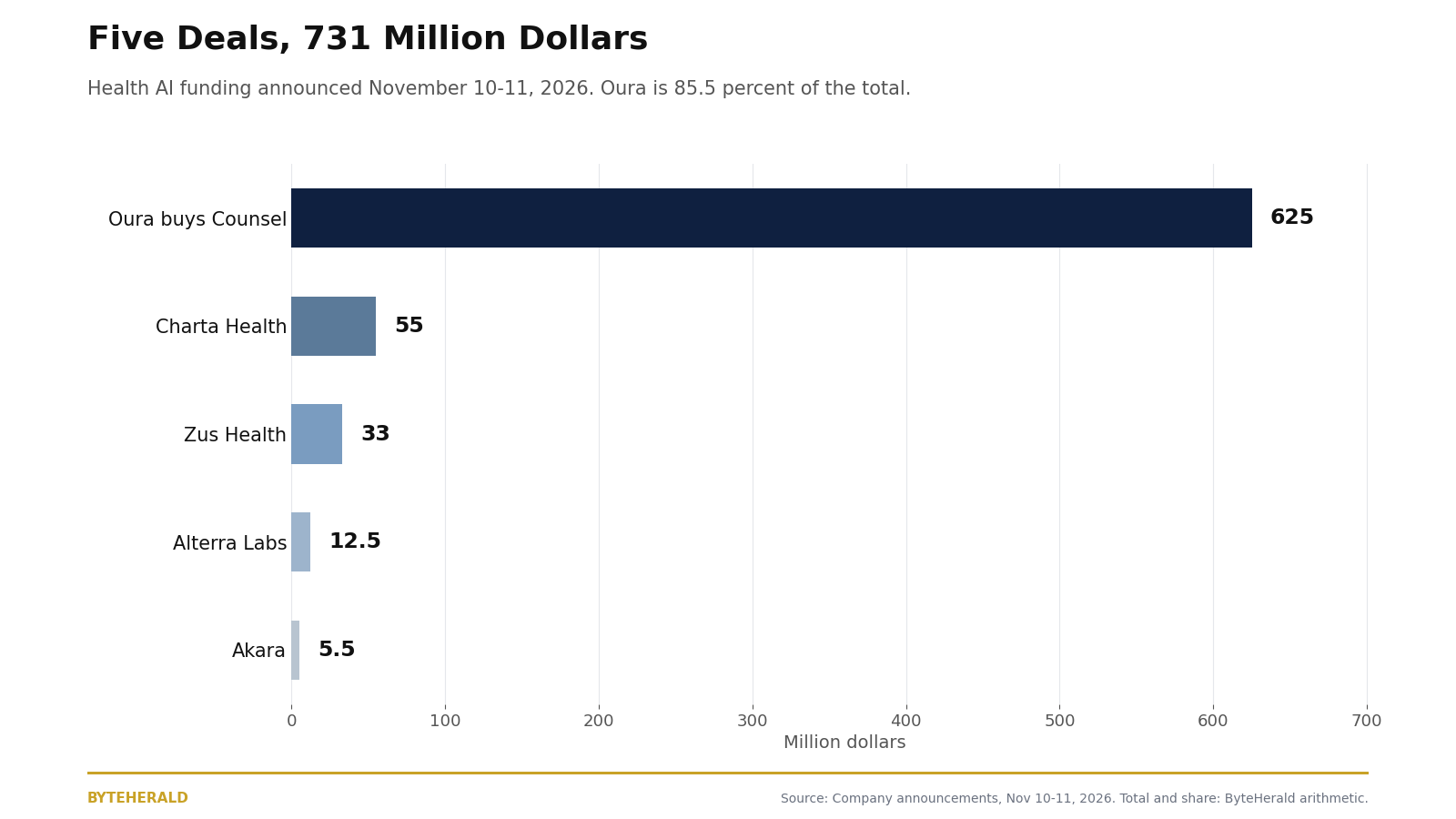
All five deals were announced on November 10 and 11, 2026. Oura, the smart ring maker, agreed to buy Counsel Health, an AI-led primary care company, for 625 million dollars in cash. Charta Health raised a 55 million dollar Series B to review medical charts for billing accuracy. Zus Health raised a 33 million dollar Series B to connect fragmented patient records. Alterra Labs raised a 12.5 million dollar seed round to train and evaluate medical AI in simulated clinical environments. Akara raised 5.5 million dollars to bring privacy-preserving sensors and AI to hospital operations. By ByteHerald's arithmetic, the five deals total 731.0 million dollars, Oura's purchase is 85.5 percent of it, and the other four combined are 106 million dollars. Oura's price is also about 17 times the roughly 36 million dollars Counsel had raised in total, and about 36 percent of Oura's own fiscal 2026 revenue of about 1.75 billion dollars, by ByteHerald's arithmetic.
| Date | Deal | Amount | Lead or buyer | What it is |
| Nov 10 | Oura acquires Counsel Health | 625 million dollars cash | Oura | AI-led primary care: medical AI chat plus board-certified doctors inside the Oura app |
| Nov 10 | Charta Health Series B | 55 million dollars | Insight Partners | AI review of medical charts for billing accuracy, for providers and payers |
| Nov 10 | Zus Health Series B | 33 million dollars | Drive Capital | Connects fragmented patient records into one networked record for AI clinical workflows |
| Nov 10 | Alterra Labs seed | 12.5 million dollars | Oak HC/FT | Simulated clinical environments that train and evaluate medical AI |
| Nov 11 | Akara funding | 5.5 million dollars | Locke Health | Privacy-preserving sensors plus AI for hospital operations |
Six layers, one week of buying
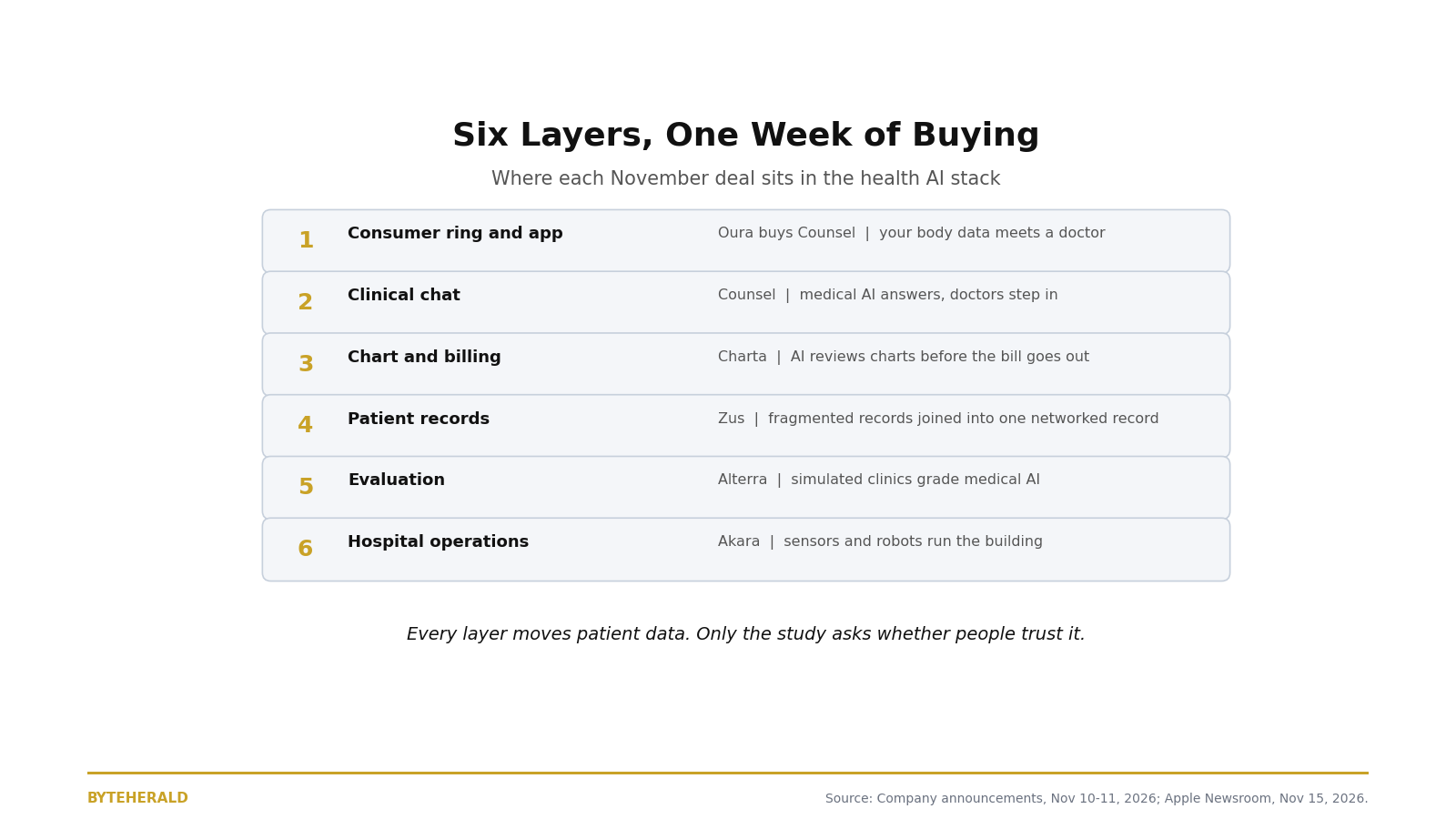
Put the five deals together and they map the whole health AI stack, from the wrist to the hospital basement. Oura owns the consumer layer: the ring and the app, with Counsel's doctors now inside it. Counsel is the clinical chat layer: a medical AI that answers first, with licensed physicians stepping in when the AI should not answer alone. Charta is the chart and billing layer: AI that reads the medical record before the bill goes out, sold to both the provider and the payer. Zus is the records layer: the networked medical record that joins fragmented data so AI workflows have something complete to work on. Alterra is the evaluation layer: simulated clinics where physicians grade what medical AI does, including the cases where it reaches the right answer for the wrong reasons. Akara is the hospital operations layer: sensors and robots that track how rooms are used, coordinate services and cut administrative work. Every layer moves patient data. Only one of them, the evaluation layer, is in the business of asking whether the AI is right.
| Layer | Who | What data moves | What is promised | What is unproven |
| Consumer ring and app | Oura | Continuous biometric data: sleep, heart rate, activity | A doctor behind the ring | Whether members use it, and at what price |
| Clinical chat | Counsel | Symptoms and questions, answered by AI then doctors | Primary care inside an app | Outcomes vs ordinary primary care |
| Chart and billing | Charta | Medical charts and coding, checked before submission | One standard of billing accuracy for both sides | Revenue growth of 10 times is company-reported only |
| Patient records | Zus | Records from EHR networks, pharmacies, labs | One networked record for AI workflows | Whether connectivity becomes clinical value |
| Evaluation | Alterra | Simulated cases and model decisions, graded by physicians | Medical AI that is tested before it is trusted | Customers named only as categories, not companies |
| Hospital operations | Akara | Room use and movement, from thermal sensors | More patients treated, less admin | No named customers, no site count, no verified time saved |
The trust test
Apple announced the Apple Health AI Usage Study on November 15, 2026, conducted with OpenEvidence, a clinical AI platform widely used by health professionals. The study is open to up to 200,000 eligible adults in the United States, age 21 and older, with an iPhone 15 Pro or later running iOS 26 or later. Participants ask everyday health questions in a dedicated app and receive answers from OpenEvidence, with linked peer-reviewed citations from journals such as The New England Journal of Medicine, JAMA and Nature. The study examines trust, response quality, comprehension and everyday health actions. Sharing Health app data, such as resting heart rate, sleep and lab results, is optional. Apple says study data will not be used to train AI models, and CNET and MacRumors report that OpenEvidence deletes questions and answers within 24 hours, a detail not stated in Apple's announcement. The app is not intended to diagnose or treat any condition, or replace advice from medical professionals. A third of US adults are already in this territory: a KFF Tracking Poll on Health Information and Trust, fielded February 24 to March 2, 2026, among a nationally representative sample of 1,343 US adults, found that 32 percent said they had used AI chatbots for health information in the prior year. The study measures, at scale, whether people can tell a good health answer from a bad one.
Three questions before you trust any of it
The week's buying raises three questions that apply to every layer of the stack. First, who sees your data. The reports do not say how biometric and health data will be handled under the combined Oura and Counsel service. Apple's study answers the question directly: study data will not train models, and sharing Health app data is optional. Zus moves records across organizations by design, which is the point of the product and the reason its privacy terms deserve a close read. Akara's sensors are thermal, so they track room use without capturing detailed images of patients or staff, which is a privacy claim, not an independent audit. Second, who is liable when the AI is wrong. Counsel pairs its medical AI with licensed physicians, so a human is in the loop by design. Alterra grades models on right answers reached for wrong reasons, which is the failure that matters most in medicine. Apple's app is explicitly not a diagnostic tool, which limits what it can be blamed for. Third, what does it cost. Oura paid 625 million dollars, about 36 percent of its fiscal 2026 revenue, for a company that had raised about 36 million dollars. That is the price of the bet. The price to the user is still unannounced, and it is the number that will decide whether any of this reaches ordinary patients.
What is not proven
None of the five deals is an outcome. They are announcements, and the announcements themselves carry the limits. Oura's release says the Counsel deal is expected to close before the end of the calendar year; TechCrunch reported the close as expected before the end of 2027, and the company's text is the one to plan against. Charta's revenue growth of 10 times in 12 months is company-reported, with no absolute figure disclosed. Alterra says its customers include several frontier AI labs, hospitals and medical societies, but names none of them. Akara names no customers, gives no site count, and offers no independently verified figures for time saved or patients treated. Apple's study has no results yet, no publication date, and a maximum enrollment, not a reported total. The week's real story is not that health AI raised money. It is that the money and the trust question arrived in the same week, and the trust question is the one with no answer yet.
Drug discovery is a different layer of the same stack: our October map of Anthropic's drug business, six partners and no drug yet, covers the lab side of health AI, while this week covers the care side. The boldest claim in health AI came a week earlier: Anthropic's chief executive said AI will cure cancer in a decade, and doctors disagreed. The deals in this article are the market's answer to that argument: buy the plumbing first, argue about the cures later.
By ByteHerald Staff. Counsel Health announced on November 10, 2026, that Oura will acquire Counsel Health for 625 million dollars in cash, subject to purchase price adjustments, that the deal is expected to close before the end of the calendar year, that founder Muthu Alagappan will become Oura's chief clinical AI officer, and that Oura's preliminary fourth-quarter revenue was 533 million dollars, up 153 percent year over year, with fiscal 2026 revenue of about 1.75 billion dollars, up 92 percent. Charta Health announced on November 10, 2026, that it raised a 55 million dollar Series B led by Insight Partners, bringing its total funding to 85 million dollars, and that it will launch Charta for Providers and Charta for Payers. Zus Health announced on November 10, 2026, that it raised a 33 million dollar Series B led by Drive Capital, bringing its total funding to over 100 million dollars, that its network supported more than 110 million transactions in August, and that its platform generated 39 million evidence citations year to date. Alterra Labs announced on November 10, 2026, that it raised a 12.5 million dollar seed round led by Oak HC/FT, with Flare Capital Partners, Company Ventures and Tau Ventures participating, to build simulated clinical environments that train and evaluate medical AI. Akara announced on November 11, 2026, that it raised 5.5 million dollars led by Locke Health, bringing its total funding to 12.3 million dollars, to expand privacy-preserving AI for hospital operations. Apple announced on November 15, 2026, that its Health AI Usage Study with OpenEvidence is open to up to 200,000 eligible US adults age 21 and older, that study data will not be used to train AI models, and that the app is not intended to diagnose or treat any condition. A KFF Tracking Poll on Health Information and Trust, published March 25, 2026, and fielded February 24 to March 2, 2026, among a nationally representative sample of 1,343 US adults, found that 32 percent of US adults said they had used AI chatbots for health information in the prior year. TechCrunch reported that the Oura and Counsel deal is expected to close before the end of 2027, against the companies' stated close before the end of the calendar year.
Comments
Post a Comment