Nvidia clarified on its third-quarter earnings call on November 17, 2026, that its guarantees for data center projects only take effect once the customer has secured financing, built the facility and installed Nvidia products. If those conditions are not met, the guarantee "doesn't exist", interim chief executive Colette Kress told analysts. The company also disclosed 32 billion dollars in commitments related to neoclouds, the specialist cloud providers that rent out Nvidia chips, and 118 billion dollars in total guarantees at the end of the quarter.
The clarification, in Kress's words
The question on the call was whether Nvidia would keep bankrolling its customers at the pace set under Jensen Huang, who resigned on November 11. Kress's answer drew a line between guaranteeing a loan and providing the financing. "There is the raising of capital that they may need through equity and or debt, in order to build out any of the buildings, get them ready for use, but also the ability to procure the compute, install the compute, and get ready. What we are indicating in our statement there is that is when our guarantee starts. So if all of that begins and unfortunately they are delayed or they have a challenge in terms of building that, our guarantee doesn't exist anymore," she said.
She pointed to the OpenAI PORTS-Pike campus in Ohio as the example. The project carries a 105 billion dollar backstop from Nvidia, announced in August, in exchange for OpenAI's promise that the campus would use Nvidia equipment exclusively. Kress reportedly cut that backstop from 250 billion dollars to 105 billion dollars before it was announced. When asked whether the clarification was a change in policy, she said it was not a change but "simply a clarification of existing terms. However, these disclosures have never been public before."
The numbers behind the words
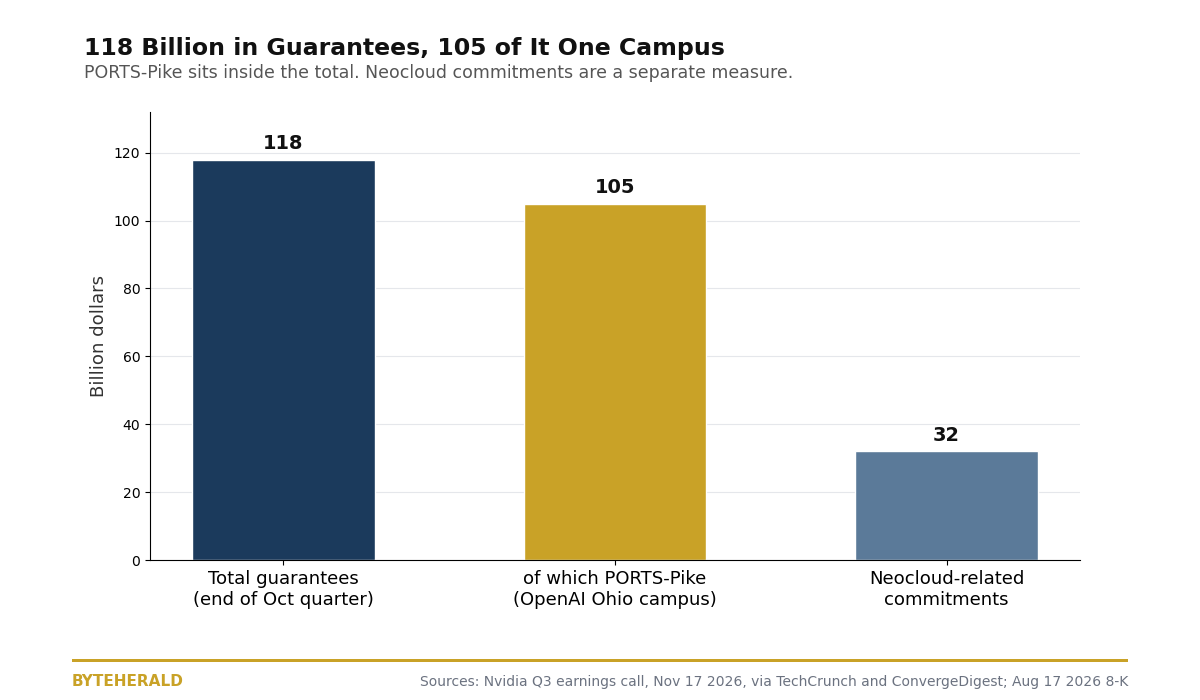
The earnings call put fresh totals on the exposure. Total guarantees stood at 118 billion dollars at the end of the quarter, including the 105 billion dollars of credit support for the PORTS-Pike campus. Commitments related to neocloud agreements stood at 32 billion dollars. The July quarter's filing had listed maximum guarantee exposure of 108.5 billion dollars, so the total rose by about 9.5 billion dollars between the two quarters, on the measures as disclosed. Land, power and shell guarantees for selected AI cloud partners' data center leases stood at 3.5 billion dollars in the July filing, over terms of five to seven years and partly offset by 712 million dollars the partners placed in escrow.
| Disclosed total | Amount | What it is |
| Total guarantees, end of October quarter | 118 billion dollars | Total guarantees as disclosed on the earnings call, including PORTS-Pike |
| PORTS-Pike credit support | 105 billion dollars | Residual-value guaranty on the OpenAI Ohio campus, capped at 105 billion dollars |
| Neocloud-related commitments | 32 billion dollars | Commitments under neocloud agreements, a separate measure from guarantees |
| Land, power and shell guarantees, July quarter | 3.5 billion dollars | Lease guarantees for selected AI cloud partners, 5 to 7 year terms |
| Buyback authorization remaining | 227.3 billion dollars | Authorization remaining, to be used through fiscal 2028 |
The PORTS-Pike guaranty has its own mechanics, set out in an August 17 filing with the Securities and Exchange Commission. It covers residual value: if OpenAI's insolvency causes a lease default or OpenAI stops paying, Nvidia covers the gap between the lease's guaranteed minimum value and what the lessor recovers by re-leasing or selling the site. The filing covers about 4.25 gigawatts of IT load, with up to 3.8 gigawatts more of credit support at Nvidia's discretion. Nvidia's payment obligations are expected to begin in 2028, tied to ready-for-service conditions, and OpenAI agreed to reimburse and indemnify Nvidia for anything it pays out. The obligation ends if OpenAI reaches a satisfactory credit rating, which it does not currently have.
Why this matters now
The clarification lands in the middle of Nvidia's leadership transition, and it reads as the new management's answer to the criticism Huang faced. Under Huang the company aggressively invested in AI startups and neoclouds and began guaranteeing massive loans to finance new data centers. Critics called it circular: invest in customers so they turn around and buy Nvidia products. Kress is not pulling the rug out, and she said so on the call: Nvidia will keep helping new data centers, and land, power and shell are "one of our top priorities" because a site with those three in place "is a great asset for anyone to hold". But she also said the company will be "far more selective" and is "taking a very strong look in terms of the types of companies that we would want to help in terms of the financing."
The numbers show why the market is watching the selectivity. Nvidia reported GAAP net income of 65.3 billion dollars for the quarter, up from 59.7 billion dollars the prior quarter, and revenue of 115.8 billion dollars, up 103 percent from a year earlier. At the same time it is carrying 118 billion dollars of guarantees and 227.3 billion dollars remained under its share repurchase authorization through fiscal 2028. We put the industry's debt on the record on November 3: 3.2 trillion dollars of AI buildout debt that nobody put on a balance sheet, and the guarantees are the part of it that sits closest to Nvidia's own books. Kress herself is the board's interim chief executive, named on November 11, the day the board accepted Huang's resignation; the search for a permanent successor was announced the next day.
What a guarantee is, and is not
A guarantee in this market is not a loan. Nvidia is not handing the customer the money to build the data center. In the neocloud model Kress described on the August earnings call, Nvidia gives a project a take-or-pay commitment on part of its capacity and a minimum revenue guarantee that lets lenders underwrite the build, then takes a share of the rental revenue above that floor. Kress has described the result as getting paid twice, once on the hardware sale and again through the share of rental revenue. The residual-value guaranty on the OpenAI campus works differently again: Nvidia only pays if the lease fails and the site cannot be re-leased or sold for its guaranteed value. The common thread is timing. In every version, the money Nvidia might pay arrives after the project is built, financed and running, and the November 17 clarification says the guarantee does not even exist until then.
What the clarification does not change
The clarification does not establish that Nvidia is withdrawing from neocloud financing. Kress said the company will keep helping new data centers and named land, power and shell as a top priority. It does not establish a policy change, because Kress said explicitly that it is a clarification of existing terms, not a new policy. The 118 billion dollars is maximum exposure, not cash spent, and the 32 billion dollars is commitments, not guarantees, so the two figures cannot be added together. The 108.5 billion dollar July figure and the 118 billion dollar October figure also come from different disclosures, a quarterly filing and an earnings call, so the 9.5 billion dollar rise is a comparison of the numbers as disclosed, not a like-for-like audited change. And the selectivity does not settle which neoclouds survive: the ones with land, power and a shell in place are the ones Kress named as priorities, and the ones without them are the ones the guarantee will not reach.
By ByteHerald Staff. TechCrunch reported on November 18, 2026, that interim chief executive Colette Kress said on Nvidia's third-quarter earnings call that its guarantees only take effect once the customer has secured financing, built the facility and installed Nvidia products, that if those conditions are not met the guarantee "doesn't exist", that the company reported GAAP net income of 65.3 billion dollars for the quarter, up from 59.7 billion dollars the prior quarter, and that the 105 billion dollar backstop for OpenAI's PORTS-Pike campus in Ohio was cut from 250 billion dollars. Nvidia's third-quarter earnings call of November 17, 2026, is the source of Kress's guarantee remarks and of the 32 billion dollar neocloud commitments and 118 billion dollar total guarantees, and Nvidia's filing of August 17, 2026, with the Securities and Exchange Commission sets out the PORTS-Pike residual-value guaranty, its 105 billion dollar cap and its 4.25 gigawatt scope. ConvergeDigest reported on November 17, 2026, that Nvidia disclosed 32 billion dollars in neocloud-related commitments and 118 billion dollars in total guarantees at the end of the quarter, including the 105 billion dollars of credit support for PORTS-Pike, and that 227.3 billion dollars remained under the company's buyback authorization through fiscal 2028. FourWeekMBA reported in November 2026, from Nvidia's filing for the quarter ended July 26, 2026, that maximum guarantee exposure was 108.5 billion dollars, that land, power and shell guarantees for AI cloud partners stood at 3.5 billion dollars over five to seven year terms, partly offset by 712 million dollars in escrow, and that Kress described the neocloud model as getting paid twice, once on the hardware sale and again through a share of rental revenue. SiliconSandStudio reported in October 2026, from Nvidia's August 17 filing, that the PORTS-Pike residual-value guaranty is capped at 105 billion dollars, covers about 4.25 gigawatts of IT load with up to 3.8 gigawatts more at Nvidia's discretion, that payment obligations begin in 2028, and that OpenAI agreed to reimburse and indemnify Nvidia.
Comments
Post a Comment