Five American technology companies, Alphabet, Microsoft, Amazon, Meta, and Oracle, carried about $3.2 trillion in off-balance-sheet AI-related obligations at the end of September 2026, almost double the level six months earlier, according to a Nikkei Asia compilation of the companies' latest earnings disclosures and estimates, published November 4, 2026. The figure is not debt in the usual sense, and that is precisely why it matters: it is a stack of signed future payments that sits in footnotes, not on the balance sheet most investors read first.
The ledger, in one table
Nikkei's compilation covers purchase commitments and lease obligations that have not yet begun, tied to chips, servers, and data-center capacity. About 60 percent of the total consists of purchase commitments and about 40 percent of lease obligations that have yet to begin, by Nikkei's split. Applying that split to the $3.2 trillion total gives about $1.92 trillion in purchase commitments and about $1.28 trillion in not-yet-begun leases, by ByteHerald arithmetic, and those two derived figures should be read as arithmetic on Nikkei's rounded total, not as numbers Nikkei printed.
| Company or group | Off-balance-sheet AI obligations, end of September 2026 | Share of the $3.2 trillion total | Change vs end of March 2026 |
|---|---|---|---|
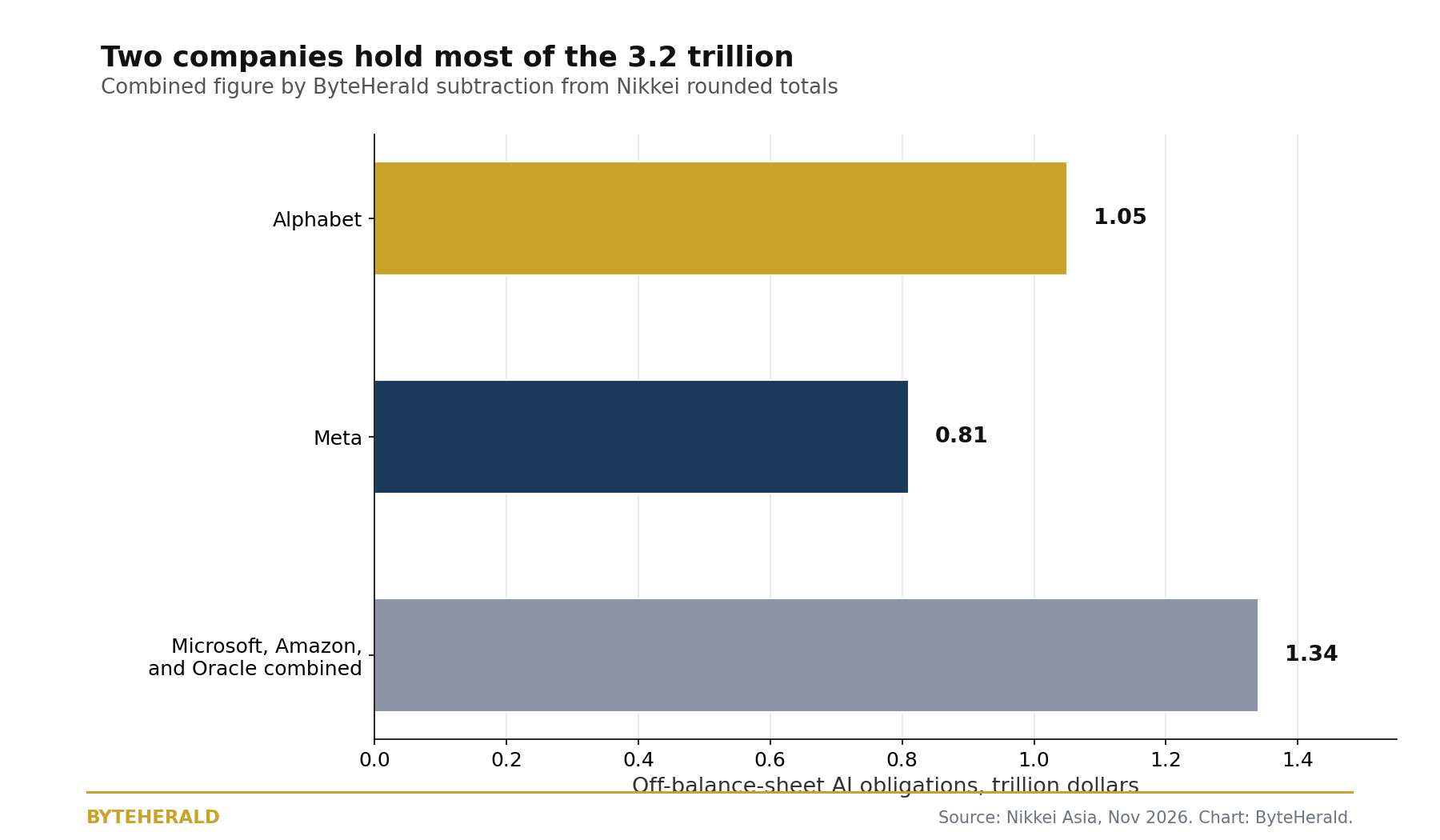
| Alphabet (Google) | About $1.05 trillion | 32.8 percent, by ByteHerald arithmetic | About 160 percent higher, with a methodology change noted below |
| Meta | About $810 billion | 25.3 percent, by ByteHerald arithmetic | Up 90 percent |
| Microsoft, Amazon, and Oracle combined | About $1.34 trillion, by ByteHerald subtraction | 41.9 percent, by ByteHerald arithmetic | Not broken out per company by Nikkei in the reported figures |
| Five-company total | About $3.2 trillion | 100 percent | Almost double in six months; headline growth 90 percent |
Two features of the table deserve attention before any conclusion. First, concentration: Alphabet and Meta together account for about $1.86 trillion, or 58.1 percent of the total, by ByteHerald arithmetic, so the story is mostly two companies' commitments plus three more. Second, comparability: Nikkei itself notes that direct comparison for Alphabet is difficult because the company appears to have changed part of its calculation methodology, which means Alphabet's 160 percent rise mixes real growth with a changed yardstick, and no reader should treat it as a pure growth rate. The residual $1.34 trillion for Microsoft, Amazon, and Oracle combined is ByteHerald subtraction from Nikkei's rounded total and rounded company figures, so it carries rounding error; it is not a Nikkei per-company figure, and it must not be quoted as one.
What counts as hidden debt, and what does not
The obligations in this ledger are future lease obligations and multi-year purchase contracts for chips, servers, and data-center capacity, disclosed in SEC footnotes rather than on the balance sheets investors read first. A lease that has not yet begun is a signed commitment to pay for a building that is not yet in service. A purchase commitment is a signed contract to buy hardware or capacity over future years. Neither is a loan drawn today, and neither appears as debt on the balance sheet until the facility enters service or the purchase falls due, which is why the word hidden describes where the number sits, not whether it was disclosed. Every figure here comes from a filing or a disclosed estimate; the criticism is about prominence, not secrecy.
That framing also sets the limits of the alarm. Some commitments can be renegotiated, delayed, or cancelled, usually at a price, so the $3.2 trillion is a ceiling on signed obligations, not a bill due tomorrow. Leases that have not begun will enter the balance sheet when the facilities come into service, which converts a footnote into a liability gradually, building by building, rather than all at once. And different tallies measure different scopes: a Bloomberg tally of the same companies' filings published October 30, 2026, put the total above $3 trillion, with Alphabet above $1 trillion and Meta above $800 billion, which corroborates Nikkei's order of magnitude while differing in detail, as expected when two tallies use different filing dates and definitions. A reader who sees $3 trillion in one tally and $3.2 trillion in another is seeing scope and timing differences, not a contradiction.
How the stock of commitments compares with the flow of spending
The ledger gains meaning when set against the spending and financing ByteHerald has already tracked. Our 2026 capex ledger for five companies put full-year spending at $803 billion to $828 billion, so the $3.2 trillion stock of future obligations is roughly four times one year of that spending, by ByteHerald arithmetic, and it covers a different set of companies and a longer horizon, which is why the comparison is a scale check rather than a precise ratio. Our November financing ledger mapped the instruments paying for the buildout, from Oracle's $20 billion stock and bond raise to Microsoft's $25 billion in notes and SpaceX's $40 billion GPU lease, and the hidden-debt ledger is the other side of those instruments: the financing tells you how companies raise money today, while the commitments tell you what they have already promised to pay tomorrow. And the structure is not unique to the five giants: Anthropic's own filing showed about $895 billion in aggregate committed spend, built from the same ingredients, contractual obligations plus leases not yet commenced, at a single company. The pattern is industry-wide, and the five-company total is its largest expression.
Three questions separate a careful reading of any future tally from a panicked one. First, is the obligation a lease or a purchase commitment, since a lease converts to a liability when a building opens while a purchase contract binds regardless of whether the capacity is ever needed. Second, when does it start, since a commitment beginning in 2030 constrains a company differently from one beginning next quarter. Third, can it be cancelled, and at what price, since a cancellable commitment is an option with a fee, not a fixed debt. Any tally that answers none of those three questions is a headline, not an analysis, and the next tally that does answer them will be worth more than this one even if its total is smaller.
By ByteHerald Staff. Nikkei Asia, November 4, 2026, compiled from the latest earnings disclosures and estimates for Alphabet, Microsoft, Amazon, Meta, and Oracle, reporting about $3.2 trillion in off-balance-sheet AI-related obligations, almost double in six months with headline growth of 90 percent, about 60 percent purchase commitments and 40 percent lease obligations yet to begin, Alphabet at $1.05 trillion as of September 30, 2026, about 160 percent higher than at the end of March 2026 with a calculation methodology change noted, and Meta at about $810 billion at the end of September 2026, up 90 percent from the end of March 2026. Bloomberg, October 30, 2026, as reported, tallied more than $3 trillion in future spending commitments from the same companies' filings, with Alphabet above $1 trillion and Meta above $800 billion. ByteHerald arithmetic in this article, labeled as such, derives the $1.92 trillion and $1.28 trillion split figures, the 32.8 percent, 25.3 percent, 58.1 percent, and 41.9 percent shares, the $1.34 trillion combined residual for Microsoft, Amazon, and Oracle, and the roughly four-times comparison with the 2026 capex ledger.
Comments
Post a Comment