OpenAI is doubling its free ChatGPT program for scientists, from 100,000 researchers to 200,000, and it published the study behind the expansion on November 16, 2026. The study followed 1,819 researchers in the summer pilot and reports that the scientists surveyed estimated the same work, at the same quality, would have taken nearly twice as long without AI. The offer comes with a catch the announcement states plainly: the new grants carry ChatGPT Plus, not the ChatGPT Pro the pilot participants received.
What the study actually measured
OpenAI's Economic Research team examined 580,186 scientific messages from 1,819 researchers between August 20 and September 22, 2026, and surveyed 251 participants between September 30 and October 7, publishing the results as "Science at the Frontier: How Scientists Use ChatGPT." Reading and learning was 28 percent of scientific messages on average, and writing and communicating was 27 percent. End-to-end autonomous research, where the AI coordinates literature review, ideas and analysis on its own, was 0.4 percent. The headline estimate is about 1.9 times: surveyed participants said the same work at the same quality would have taken nearly twice as long without AI. The study also names the bottleneck. Limited time or staffing was selected by 51.8 percent of respondents as a constraint on testing new ideas, and limited funding by 43.8 percent.
| Figure | Value |
| Researchers in the pilot study | 1,819 |
| Scientific messages examined | 580,186 |
| Survey participants | 251 |
| Reading and learning share of messages | 28 percent |
| Writing and communicating share | 27 percent |
| End-to-end autonomous research share | 0.4 percent |
| Estimated time without AI, same work | About 1.9 times as long |
| Named bottleneck: limited time or staffing | 51.8 percent |
| Named bottleneck: limited funding | 43.8 percent |
What the numbers do not prove
The 1.9-times figure is a self-reported estimate, not a measured speedup. The participants were a selected group who applied for expanded AI access and chose to answer an AI survey, so the results may not generalize to all scientists. Usage shares describe requests, not research value or time allocation. And the findings do not establish causal effects: the study documents how AI fits into research work, not whether it produces discoveries faster. OpenAI says all of this itself in the announcement. That honesty is worth noting, because it is exactly the standard a claim like this needs. We applied the same claim-by-claim check to OpenAI's last big science announcement, a verification ledger for three claimed breakthroughs in mathematics, computer science and physics, and the same rule holds here: a vendor's number is a starting point, not a verdict.
What the new grants include
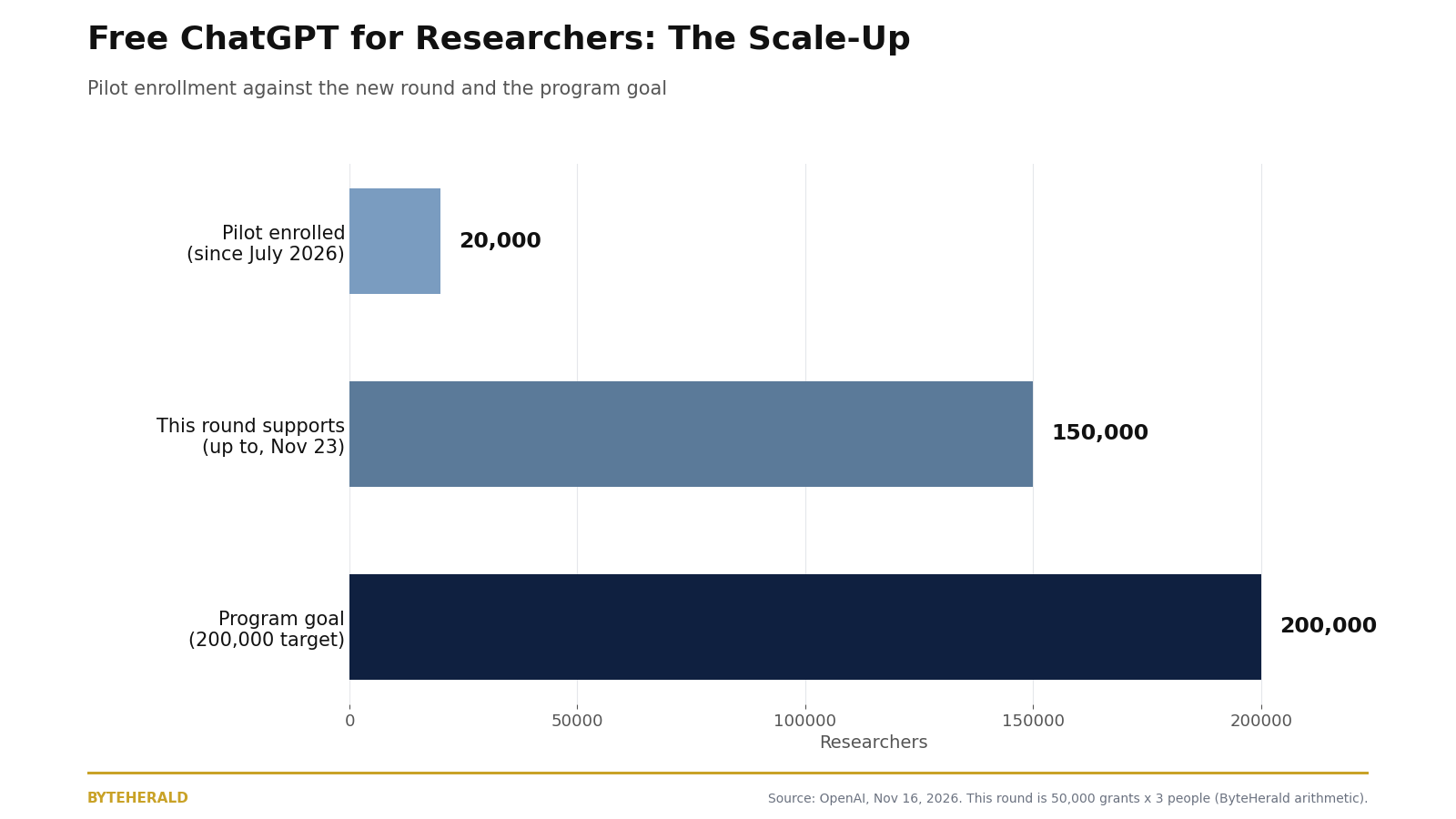
Applications for the next round open on November 23, 2026, and OpenAI will award 50,000 new grants to eligible researchers in the order they apply, replacing the lottery used in the summer pilot. Each grant gives its recipient and up to two collaborators free access to ChatGPT Plus, plus training on using it in research. By default, data shared through the program is not used to train OpenAI's models. The pilot enrolled 20,000 researchers in 33 countries since July. The program goal is now 200,000 researchers worldwide. By ByteHerald's arithmetic, 50,000 grants times three people is up to 150,000 researchers supported in this round, and the goal is ten times the pilot enrollment. The announcement also points to ChatGPT Edu for universities, GPT-Rosalind for biology researchers, and a 5 million dollar contribution to a new Simons Foundation initiative.
The catch, stated plainly
The pilot participants received ChatGPT Pro, OpenAI's top tier. The new grants provide ChatGPT Plus. OpenAI says most pilot participants would have stayed within Plus usage limits, which is why it switched the tier. The announcement does not state how long the grants last, the full eligibility requirements, or when applications close. And 200,000 is a program goal, not current enrollment: 20,000 researchers have joined so far. None of that makes the offer hollow, but it does make the headline number a promise about the future, not a count of people already in.
Google answered six days earlier
Google DeepMind had already moved: on November 10, 2026, it added free Gemini 4 Carbon to its Antigravity program for 10,000 scientists. The two offers are not the same size, and the comparison is instructive: OpenAI is scaling a program that already has 20,000 participants, while Google is opening a smaller door to its newest model. The other side of the same question is what AI does to scientists' work itself: our November 15 report on the estimate that AI could do 27 to 52 percent of a scientist's job, and what that range actually means. OpenAI's study answers the narrower question, how the scientists who already have the tool use it, and the answer is mostly reading and writing, not autonomous research.
Plus vs Pro, in plain terms
The tier change is the part of this announcement that will matter most to the researchers who apply. ChatGPT Pro is OpenAI's top tier, with the highest usage limits and access to the most capable models. ChatGPT Plus is the standard paid tier, with lower limits. OpenAI's own review found that most pilot participants did not use enough of Pro's capabilities to need it, so the company moved the new grants to Plus to reach more people. For a researcher whose work fits inside Plus limits, nothing is lost. For a researcher running long agentic jobs or heavy model use, the tier is the difference between the program being useful and being a waiting room. The honest way to read the announcement is as a trade: fewer capabilities per person, more people reached.
By ByteHerald Staff. OpenAI announced on November 16, 2026, that it is expanding its ChatGPT for Academic Researchers program to up to 200,000 researchers worldwide, that applications open November 23 for 50,000 new grants awarded first come, first served, that each grant covers the recipient and up to two collaborators with free ChatGPT Plus, and that data shared through the program is not used to train models by default. OpenAI's Economic Research team reported on November 16, 2026, in "Science at the Frontier: How Scientists Use ChatGPT," that 1,819 pilot researchers sent 580,186 scientific messages between August 20 and September 22, 2026, that reading and learning was 28 percent and writing and communicating 27 percent of scientific messages, that end-to-end autonomous research was 0.4 percent, and that surveyed participants estimated the same work would have taken nearly twice as long without AI, a self-reported estimate from a selected sample. Google DeepMind announced on November 10, 2026, that free Gemini 4 Carbon is available in its Antigravity program for 10,000 scientists. Neowin reported on November 16, 2026, that OpenAI switched the new grants to ChatGPT Plus because most pilot participants would have stayed within Plus usage limits.
Comments
Post a Comment