Five surveys in 2026 asked enterprises whether artificial intelligence is paying off, and they got five different answers. Gartner says 13 percent of CIOs see significant value. HFS Research says 33 percent of enterprises met their AI business case. Cloudera says 89 percent of enterprises redesigned their AI work and 98 percent pulled back a deployment. Menlo Ventures estimated an annualized run rate of 176.8 billion dollars in deployment spending as of September 2026. IoT Analytics found agentic autonomy jumping from 1.1 percent of projects to 17.8 percent in its Q1 2026 sample of 174 projects. All five are right, because they measured different things, asked different people, at different moments of the same year. The confusion is not in the data. It is in quoting one survey's number as if it were the whole story.
The table: five surveys, five questions
Read the table before quoting any single number from it, because the question each survey asked is the number it got. The same enterprise could honestly answer yes to one of these questions and no to another, and the surveys below prove it.
| Survey | Field dates | Sample | Question asked | Headline number | What it actually measured |
| Gartner, 2027 CIO and Technology Executive Agenda | May to July 2026 | 2,002 CIOs and technology executives | Has your enterprise realized significant or transformational value from AI? | 13% yes | Value realization among CIOs, while AI use cases grew 400% |
| HFS Research with Rackspace | August to September 2026 | 502 senior AI decision-makers, enterprises over 100 million dollars revenue | Has your most significant AI program met or exceeded its business case? | 33% yes; 38% partially; 11% not delivered | Business-case delivery on the single biggest program; 96% report significant governance gaps |
| Cloudera, State of Enterprise AI 2026 (Wakefield) | September 2026 | 1,500 IT leaders | How are token costs, governance and placement shaping your AI scale-up? | 89% limited or redesigned; 98% pulled back a deployment | Redesign and pullback under cost and governance pressure, not value |
| Menlo Ventures, 2026 State of Enterprise AI | September 8 to 26, 2026 | About 400 US enterprise decision-makers (Morning Consult) | How much are enterprises spending on AI, and on what? | 176.8 billion dollars, annualized run rate as of September 2026 (modeled estimate) | Spending, not value: apps 77 billion, coding 34 billion, assistants 25 billion; budgets overshoot 2.5 times on average, about 1.2 times at the median |
| IoT Analytics | 2026 (Q1) | 1,533 AI projects tracked; autonomy figures from the Q1 2026 subset of 174 projects | How far have agents got in production? | Autonomy 1.1% to 17.8% (174-project subset) | Deployment stage of real projects, not whether they paid off; IoT Analytics warns the subset shows direction, not a stable share |
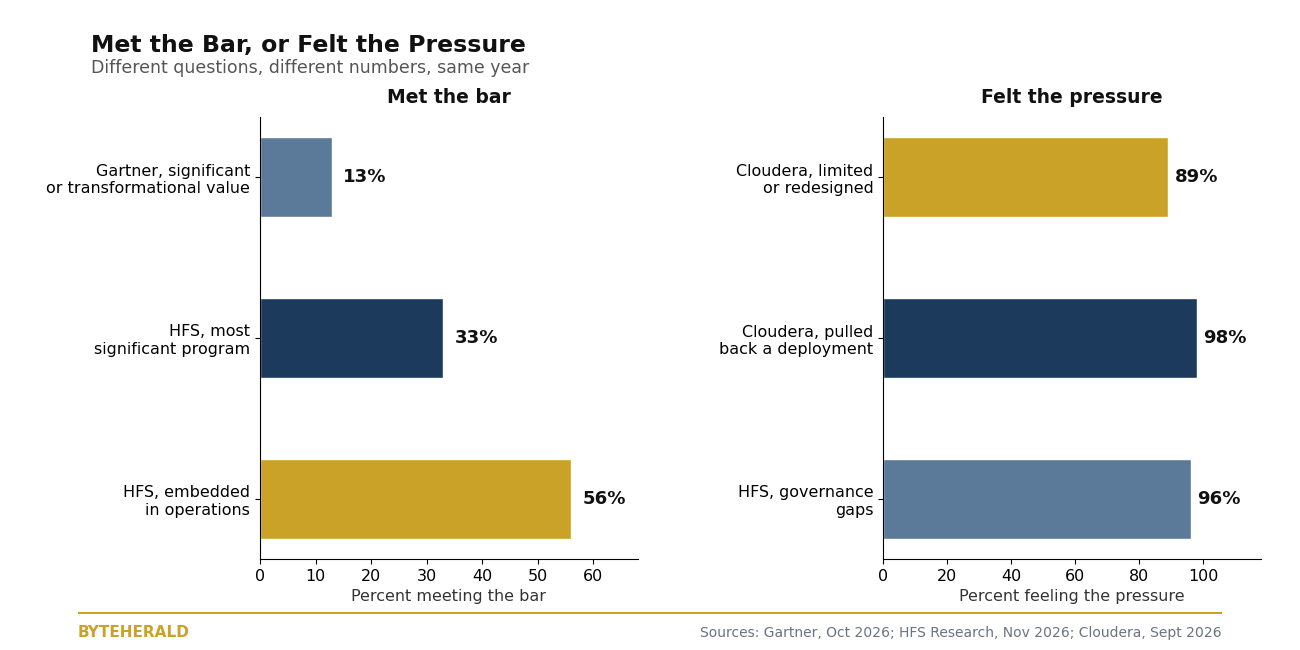
The arithmetic behind the table is ByteHerald's own, and it is worth doing because the percentages hide the headcounts. Gartner's 13 percent is about 260 of its 2,002 CIOs. HFS's 33 percent is about 166 of its 502 decision-makers, with about 191 saying partially met and about 55 saying not delivered. Cloudera's 89 percent is about 1,335 of its 1,500 IT leaders. These are different rooms of people, and the rooms disagree because they were asked different questions.
Why the numbers disagree
The first reason is the question. Gartner asked about significant or transformational value, the highest bar in the table, and got the lowest number. HFS asked whether the single most significant program met its business case, a lower bar, and got 33 percent. Cloudera did not ask about value at all; it asked what cost and governance forced enterprises to change, and 89 percent said they limited or redesigned work. A company can have redesigned its AI program, pulled back a deployment, and still have its biggest program meet its business case. Nothing in these numbers contradicts anything else, because they are answers to different questions.
The second reason is the population. Gartner asked CIOs, who answer for the whole technology estate. HFS asked senior AI decision-makers at companies already running AI, a group that has already decided the technology is worth running. Cloudera asked IT leaders, who feel token costs first. Menlo counted buyers' spending. IoT Analytics counted projects, not people. How many enterprises use AI at all is a different question from the ones in this table, and none of these five surveys answers it, because all five start with companies already running AI. The HFS study is explicit about its own limit: it describes AI-active enterprises, not market-wide adoption, and its sample is companies with at least 100 million dollars in annual revenue across eight industries and four regions.
The third reason is the date. Gartner's fieldwork ran May to July, before the autumn's cost and governance arguments. HFS and Cloudera fielded in August and September, after them. A survey is a photograph, and these photographs were taken months apart in a year when the argument itself was moving. The sponsors matter too, and they are stated here rather than hidden: HFS conducted its study with Rackspace, a vendor; Cloudera's survey is its own State of Enterprise AI; Menlo Ventures, which published the spending ledger, is an investor in Anthropic and OpenRouter, a fact our November 3 report disclosed. Gartner and IoT Analytics are independent research. None of that makes any number wrong. It makes each number a product of who asked, whom, when, and what exactly they asked.
What the surveys agree on
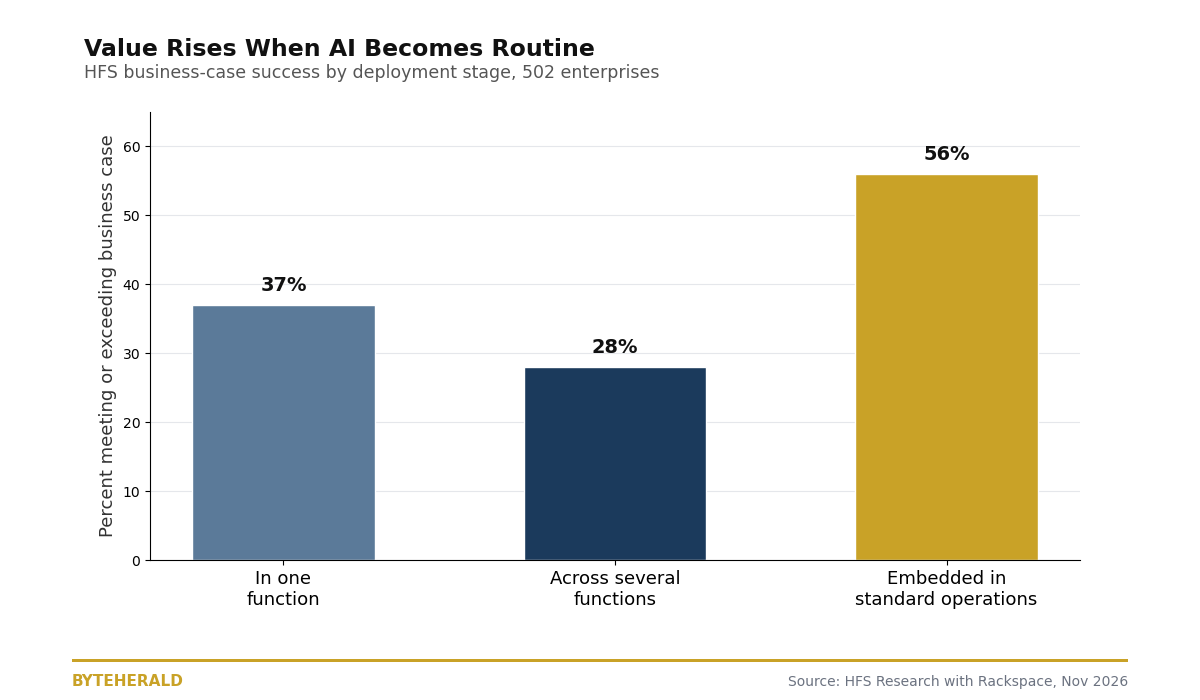
For all their different questions, the surveys converge on one finding, and it is the finding that matters most. Value concentrates where AI stops being a project and becomes part of how the company operates. HFS found that 56 percent of enterprises with AI embedded in standard operations met or exceeded their business case, against 37 percent deploying in one function and 28 percent deploying across several functions. Gartner found the same shape from the other side: 11 percent of CIOs qualified as vanguards, delivering better business outcomes while reporting high CEO-perceived AI value, and what separated them was deployment discipline, with CIOs who had pilot stop rules 2.3 times as likely to report transformational value and those with production kill rules 2.6 times as likely. Our October reckoning report laid out that discipline in full, and the scale trap report showed the cost of not having it: faster-than-expected growth in governance and compliance costs for 55 percent of Cloudera's respondents, and 45 percent moving workloads to escape them.
The second point of agreement is that the spending has not stopped. Menlo estimated an annualized run rate of 176.8 billion dollars in deployment spending as of September 2026, against 33 billion in its prior edition, about 5.4 times as much, with budgets overshooting by 2.5 times on average, though the median respondent overspent by only about 1.2 times. That is the direct answer to how much enterprises are spending on AI, and it is a spending number, not a profit number: anyone asking who actually makes money from AI will not find a name in these surveys, because they measure value, spending, and deployment, not profit. Gartner found 58 percent of CIOs under pressure to show cost improvement from AI, which means the spending continues under scrutiny rather than stopping. IoT Analytics found the work itself moving forward: agents acting autonomously rose from 1.1 percent of projects to 17.8 percent in its Q1 2026 sample of 174 projects, while output-only agents fell from 59.5 percent to 32.2 percent. The enterprises are spending more, deploying further, and getting value more slowly than they expected. That is the whole story, and every survey in the table tells a part of it.
Which number to quote
The next time a vendor, a headline, or a board deck quotes one of these numbers, ask three questions before repeating it. First, what was actually asked: value, business case, redesign, spending, or deployment stage, because the number changes with the question. Second, who was asked: CIOs, AI decision-makers, IT leaders, buyers, or projects, because the room changes the answer. Third, when: May to July is not August to September, and a survey taken before the autumn's cost arguments is not the same evidence as one taken after them. If the number survives all three questions, quote it with its survey attached. If it does not, the number was never the evidence; the table was.
By ByteHerald Staff. Gartner's 2027 CIO and Technology Executive Agenda survey of 2,002 CIOs and technology executives, conducted May to July 2026 and released October 19, 2026, found that 13 percent say their enterprise has realized significant or transformational value from AI, that 11 percent qualified as vanguards, that CIOs with pilot stop rules were 2.3 times as likely to report transformational value and those with production kill rules 2.6 times as likely, and that AI use cases grew 400 percent, as reported by ByteHerald on October 19, 2026. HFS Research reported on November 12, 2026, in a study with Rackspace of 502 senior AI decision-makers surveyed August to September 2026, that 33 percent of enterprises met or exceeded the business case for their most significant AI program, 38 percent partially met it, 11 percent said it had not delivered, and 96 percent report significant governance gaps, with success at 37 percent in one function, 28 percent across several functions, and 56 percent where AI is embedded in standard operations. Cloudera's State of Enterprise AI 2026, conducted by Wakefield among 1,500 IT leaders in September 2026, found that 89 percent limited or redesigned AI work over token costs and 98 percent pulled back a deployment, as reported by ByteHerald on October 26, 2026. Menlo Ventures' 2026 State of Enterprise AI estimated an annualized run rate of 176.8 billion dollars in deployment spending as of September 2026, against 33 billion in the prior edition, with applications at 77 billion, coding at 34 billion and assistants at 25 billion, and budgets overshooting by 2.5 times on average against about 1.2 times at the median, as reported by ByteHerald on November 3, 2026. IoT Analytics tracked 1,533 AI projects and found agentic autonomy rising from 1.1 percent to 17.8 percent in the Q1 2026 subset of 174 projects, as reported by ByteHerald on October 26, 2026.
Comments
Post a Comment