Five surveys published between October 19 and November 17, 2026, now measure the AI boom from every side at once, and they agree on the question but not on the answer. Fund managers call an AI bubble the biggest risk in markets. The Federal Reserve's contacts call AI the top risk to financial stability. Chief information officers say almost nobody has seen real value from AI. IT leaders say nearly everyone has pulled back a deployment. And enterprise buyers are still spending 176.8 billion dollars. The fear is about financing and value. The spending is about demand. Both can be true at the same time, and the test of which one wins has a date: Nvidia reports earnings after the close on November 17, 2026, and 52 percent of fund managers expect a hyperscaler to cut capital spending within six months.
The scoreboard
Each survey asked a different group a different question, and that is exactly why reading them together is useful. Bank of America asked fund managers where their money sits. The Federal Reserve asked market contacts what could break the financial system. Gartner asked chief information officers whether AI has delivered value. Cloudera asked IT leaders what scaling AI actually cost them. Menlo Ventures counted what enterprises actually spent. The table below is the first time all five have been put on one page with their samples and dates attached, so a reader can see what each number is and is not.
| Survey | Sample and date | Headline numbers |
| Bank of America fund manager survey | 169 investors, 461 billion dollars, November 6 to 12, 2026 | 34% call an AI bubble the top tail risk; 52% expect a hyperscaler capex cut within six months; tech overweight cut to 12% from 37% |
| Federal Reserve Financial Stability Report | 23 market contacts, September to October 2026; released November 13 | 87% cite AI as a salient risk, up from 50% in spring; advanced-computing debt issuance above 680 billion dollars |
| Gartner CIO survey | 2,002 CIOs and technology executives, May to July 2026; released October 19 | 13% say AI delivered significant or transformational value; use-case success about one in five |
| Cloudera State of Enterprise AI 2026 | 1,500 IT leaders, September 2026; released October 26 | 89% limited or redesigned AI use cases over token costs; 98% pulled back a deployment |
| Menlo Ventures State of Enterprise AI | Enterprise spending data, released November 3, 2026 | 176.8 billion dollars in deployment spending; budgets overshoot 2.5 times |
Bank of America: the fear, measured today
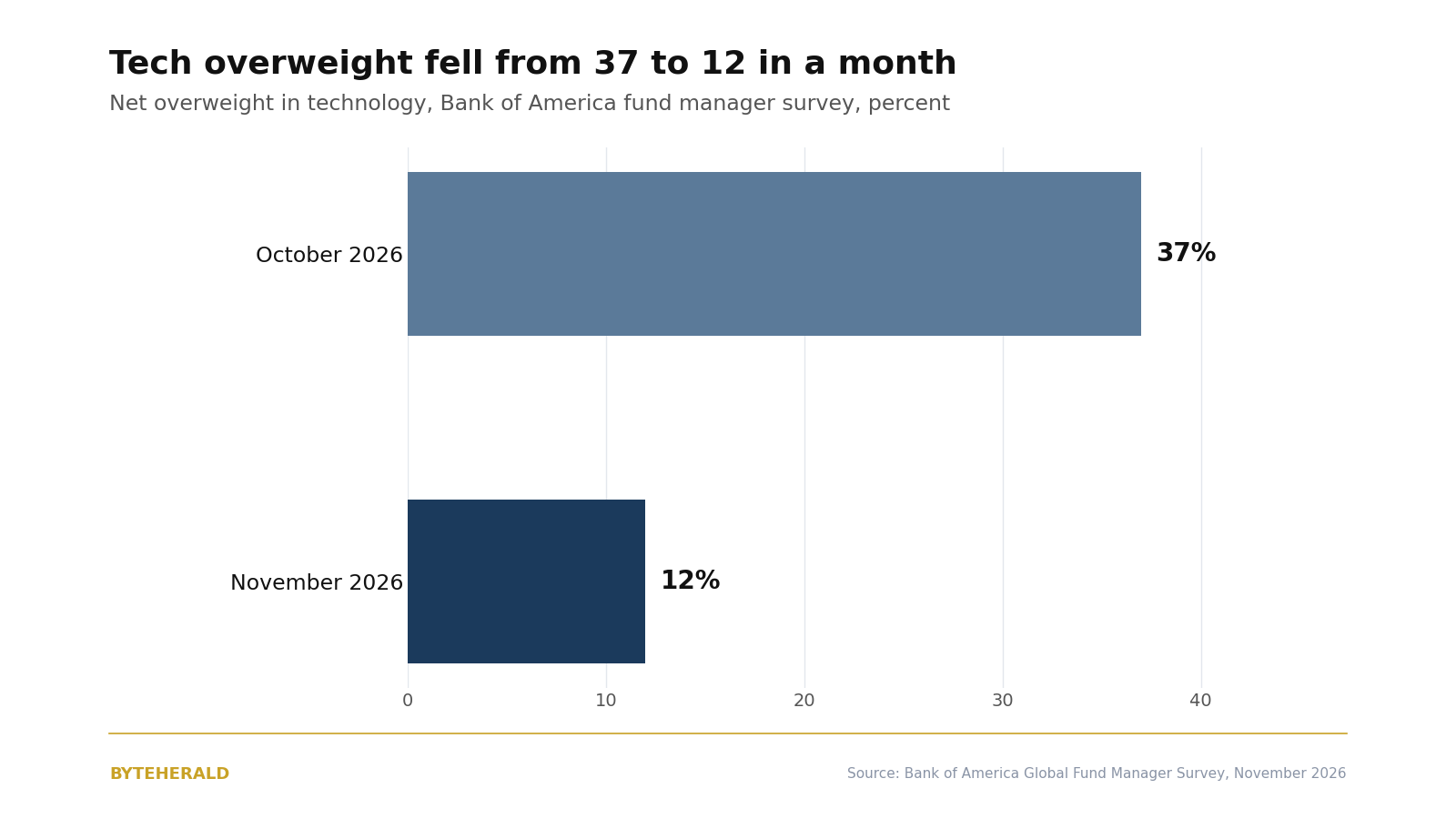
Bank of America's November survey is the freshest number on the board, published November 17, 2026, and it is the sharpest turn in the survey's recent history. Thirty-four percent of the 169 fund managers named an AI bubble their biggest tail risk, ahead of 31 percent who cited an AI-linked credit event. A record net 38 percent said companies are overinvesting in AI. Fifty-two percent expect at least one hyperscaler to cut capital spending within six months, up from 30 percent a month earlier, a 22-point rise in one month. And the positioning moved with the fear: the net share overweight technology fell to 12 percent from 37 percent, the sharpest monthly cut since June 2006. The bank's strategist Michael Hartnett said the euphoria on boom and AI is over, and the bank's analysts called a possible spending pause the survey's big message, according to Reuters. Two cautions belong with the numbers. The survey covers 169 managers, a small self-selected group of institutions, and it measures positioning intentions rather than executed trades. At 12 percent, managers are still net overweight technology, not underweight. The fear is real and it is moving money, but it has not yet become a rout.
The Federal Reserve: the leverage behind the fear
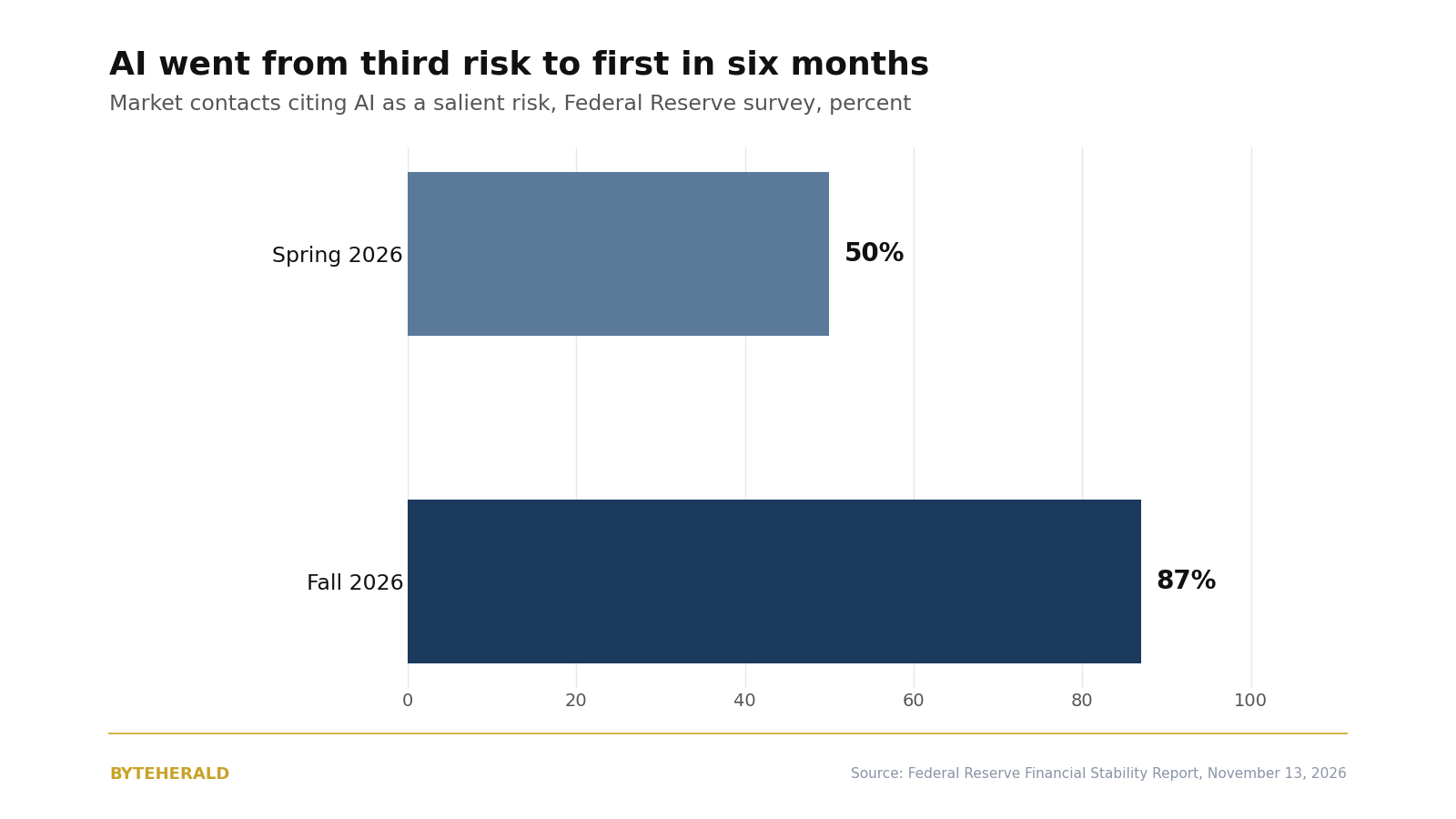
The Federal Reserve's Financial Stability Report, released November 13, 2026, gives the fear a balance sheet. In the Fed's survey of 23 market contacts, conducted in September and October, 87 percent cited artificial intelligence as a salient risk to United States financial stability, up from 50 percent in the spring survey and up from third place to first. The next most cited risks were a correction in risk assets at 52 percent, higher long-term rates at 48 percent, cyberattacks at 43 percent and fiscal debt sustainability at 43 percent. The report's box on the data-center buildout reports more than 680 billion dollars of advanced-computing-related debt issuance by October 2026, against 130 billion dollars in all of 2023, a 5.2-times rise. Not-yet-commenced leases exceeded 1 trillion dollars, and guarantees plus contract commitments exceeded 2 trillion dollars across the major technology firms tracked in the report. The seven largest AI-related firms have increased their on-balance-sheet borrowing during 2026, and the Fed expects their combined debt to exceed 800 billion dollars before year-end. The largest American banks carry close to 1 trillion dollars of exposure to AI companies. The Federal Reserve chair mapped three ways the boom ends on November 16, the same week the report landed, and his scenarios are the human version of the survey's numbers. Two limits matter. The survey records what 23 market contacts identified as risks, and respondents could name more than one category; it assigns no probability to a crisis and quantifies no losses. And the survey closed before Nvidia's chief executive resigned on November 12. Federal Reserve Governor Michael Barr, speaking November 16, added that generative AI is not yet used for autonomous trading at large scale, and that the warnings are structural rather than predictive.
The buyers: little value, constant pullbacks, spending anyway
The buyer surveys tell a stranger story than the investor surveys, because they hold two facts that should not fit together and do. Gartner's survey of 2,002 chief information officers and technology executives, fielded from May to July 2026 and released October 19, found that only 13 percent say their enterprise has realized significant or transformational value from AI so far, and it puts the likelihood of an AI use case succeeding at about one in five. Only 31 percent of CIOs have rules for when a pilot should not move to production, and only 17 percent have rules for dropping low-value AI already in production. Fifty-one percent expect AI to raise their operating costs. We read the Gartner numbers in full in October: the value gap is the story, and the missing exit rules are the mechanism. Cloudera's survey of 1,500 global IT leaders, fielded by Wakefield Research in September 2026 and released October 26, found that 89 percent have already limited or redesigned AI use cases because of rising token consumption, and 98 percent have pulled back an AI deployment due to failure, hallucinations or unexpected behavior. Eighty-four percent say data-residency and sovereignty requirements influence where workloads run. Cloudera commissioned the survey and sells the products it recommends, so the numbers are a useful signal rather than neutral science. And yet the spending continues. Menlo Ventures' 2026 State of Enterprise AI, released November 3, counts 176.8 billion dollars in enterprise deployment spending, with applications at 77 billion, coding at 34 billion and assistants at 25 billion dollars, and budgets overshooting by 2.5 times. Menlo is an investor in Anthropic and OpenRouter, which the release discloses. The buyers' verdict, read together, is not that AI is useless. It is that AI is expensive, hard to govern and hard to stop once started, and that companies are paying for it anyway.
The debt behind the spending
The spending has a financing side, and the Federal Reserve's numbers connect it to the bubble question directly. Our November 3 ledger put the off-balance-sheet stock at about 3.2 trillion dollars, nearly double in six months, with Alphabet at about 1.05 trillion and Meta at about 810 billion dollars in purchase commitments and leases. The Fed's November 13 report adds the flow: more than 680 billion dollars of advanced-computing debt issued by October, and the seven largest AI-related firms' combined borrowing on track past 800 billion dollars before year-end. The two ledgers measure different things, a stock of signed future obligations against a flow of new borrowing, and they point the same way: the buildout is being financed with promises as much as with cash. That is the precise point where the investor fear and the buyer spending meet. If the spending slows, the promises still come due. If the spending continues, the leverage keeps growing. Either way, the next number that matters is not a survey but a decision by a hyperscaler, and 52 percent of fund managers expect one within six months.
The market tape, and what would prove the fear wrong
The market has already moved on the fear. On November 16, 2026, the Nasdaq closed down 2.49 percent at 24,509.76 and the S&P 500 down 1.92 percent at 7,416.59. Nvidia's shares are down about 11 percent since November 6, fell about 13 percent on November 12 when the chief executive transition was announced, and recovered most of those losses the same day. Nvidia reports third-quarter results after the close on November 17, with consensus estimates around 2.47 dollars per share on 108.71 billion dollars of revenue, according to Koyfin. Three checks will say whether the fear or the spending wins. First, ask what each survey measured: positioning intentions, risk perception, self-assessed value, reported behavior and actual spending are five different things, and they can move in different directions without contradicting each other. Second, ask who was asked: 169 fund managers, 23 market contacts, 2,002 CIOs and 1,500 IT leaders are samples with their own interests, and a vendor-commissioned survey is not neutral science. Third, ask what would falsify the fear: a hyperscaler raising its capital guidance, Nvidia beating consensus tonight, or enterprise budgets holding through the next quarter would all say the pause is a sentiment, not a stop. Until one of those happens, the honest summary of the scoreboard is the one the surveys themselves give: the money is worried, the buyers are spending, and the leverage is real.
By ByteHerald Staff. Bank of America's November 2026 Global Fund Manager Survey, reported on November 17, 2026, by Reuters and BeInCrypto, polled 169 investors managing 461 billion dollars from November 6 to 12, found that 34 percent named an AI bubble the biggest tail risk, that 31 percent cited an AI-linked credit event, that 52 percent expect at least one hyperscaler to cut capital spending within six months, up from 30 percent a month earlier, that a record net 38 percent said companies are overinvesting in AI, and that the net technology overweight fell to 12 percent from 37 percent, the sharpest monthly cut since June 2006. The Federal Reserve reported on November 13, 2026, in its Financial Stability Report, that 87 percent of 23 market contacts surveyed in September and October cited artificial intelligence as a salient risk to United States financial stability, up from 50 percent in the spring, that advanced-computing-related debt issuance exceeded 680 billion dollars by October 2026 against 130 billion dollars in all of 2023, and that not-yet-commenced leases exceeded 1 trillion dollars while guarantees plus contract commitments exceeded 2 trillion dollars. Gartner reported on October 19, 2026, in its 2027 CIO and Technology Executive Agenda survey of 2,002 chief information officers and technology executives, that only 13 percent said their enterprise has realized significant or transformational value from AI, that the likelihood of an AI use case succeeding is about one in five, and that 31 percent have rules for when a pilot should not move to production. Cloudera reported on October 26, 2026, in its State of Enterprise AI 2026 report, based on a Wakefield Research survey of 1,500 global IT leaders in September 2026, that 89 percent have limited or redesigned AI use cases because of rising token consumption and that 98 percent have pulled back an AI deployment due to failure, hallucinations or unexpected behavior. Menlo Ventures reported on November 3, 2026, in its 2026 State of Enterprise AI, that enterprise deployment spending reached 176.8 billion dollars and that budgets overshoot by 2.5 times.
Comments
Post a Comment