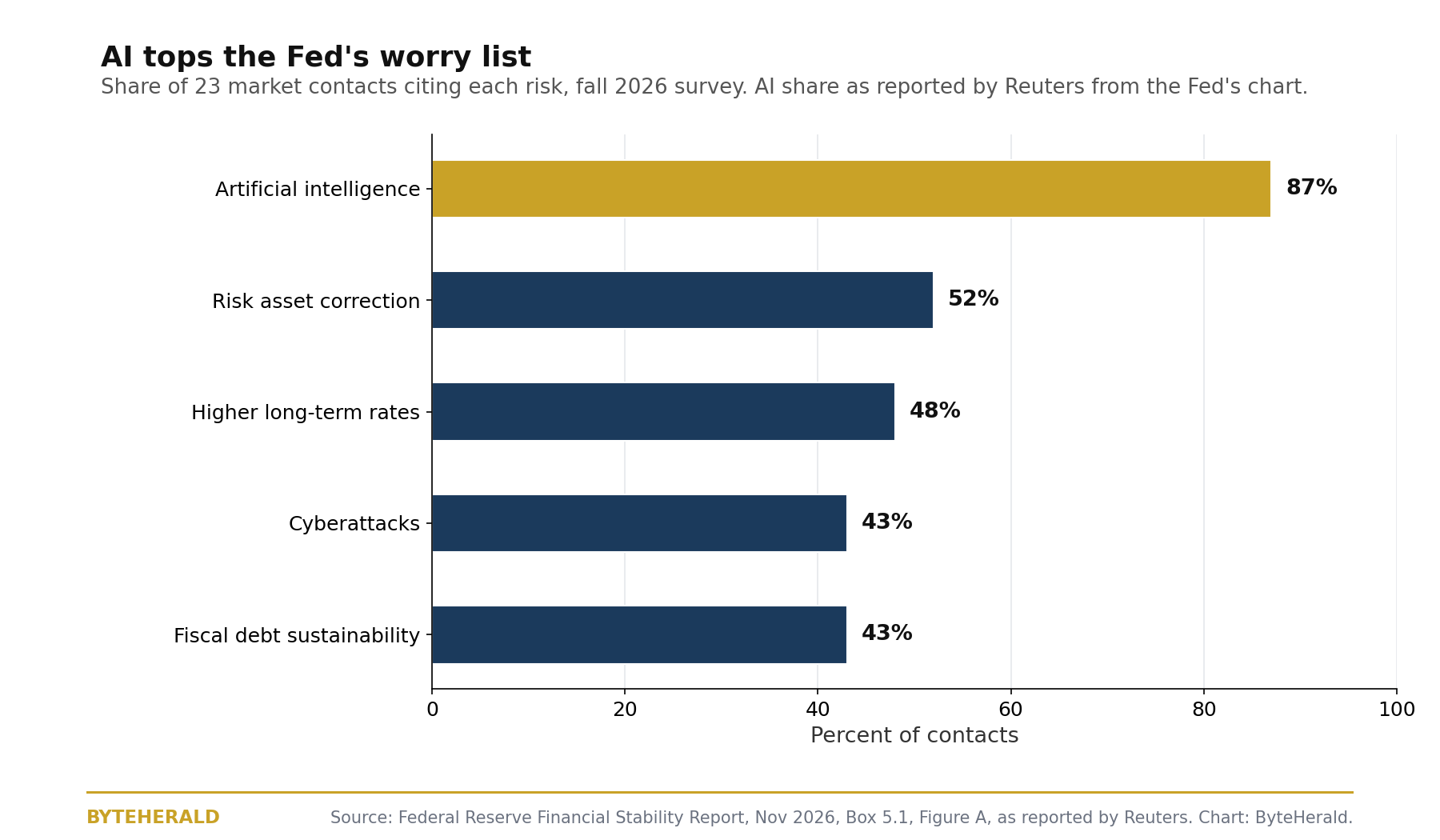
Artificial intelligence is now the risk the Federal Reserve's market contacts worry about most. The Fed's Financial Stability Report, released on Friday, November 13, 2026, says 87 percent of the 23 market contacts surveyed in September and October named AI as a salient risk to the financial system, up from 50 percent in the spring survey. The same report counts more than 680 billion dollars in debt issued to finance advanced computing infrastructure by October 2026, about five times the 130 billion dollars issued in all of 2023. The worry is not one thing. It is three: stretched valuations, cyberattacks, and the financing itself.
What the survey found
The finding comes from Box 5.1 of the Federal Reserve's Financial Stability Report, November 2026, which the Board released on November 13, 2026, with data as of October 28, 2026. Staff at the Federal Reserve Bank of New York asked 23 market contacts, professionals at broker-dealers, banks, investment funds, and advisory firms, about risks to the financial system in September and October. AI was the risk they cited most. The box carries a warning the headlines skip: it summarizes what respondents told the staff, and it should not be read as the view of the Fed's Board or the New York Fed.
Respondents named three distinct areas of concern. The first is elevated equity valuations, and the possibility that lower-than-expected earnings could result in lower valuations and a market correction. The second is cybersecurity risk, stemming from either a malicious attack by sophisticated state actors or damage caused by frontier AI models themselves. The third is risks associated with complex forms of AI-related financing. Those are the report's own words, and they matter because they split one headline worry into three different problems with three different fixes.
Respondents also widely cited a correction in risk assets, and the report spells out the mechanism: a sharp correction in AI-related equities, driven by uncertain returns on large capital expenditures. Many noted that stretched valuations, circular financing arrangements, and heavy reliance on debt to fund the AI buildout could amplify losses, with the potential for a deterioration in broader risk assets to spill over to business investment and household consumption. On cyberattacks, respondents said advances in AI are lowering the barrier to sophisticated attacks by state and non-state actors, while others pointed to unintended damage caused by frontier AI models themselves, and several warned that disruptions to trading, settlement, or payment systems could materially damage confidence in financial institutions.
The rest of the most-cited list, as reported by Reuters from the Fed's survey chart, reads: a correction in risk assets at 52 percent, higher long-term rates at 48 percent, cyberattacks at 43 percent, and fiscal debt sustainability at 43 percent. The report notes that mentions of AI, higher long-term rates, and cyberattacks saw the greatest increase relative to the spring survey, when 20 contacts were surveyed in March and April and 50 percent cited AI. The percentages are the Fed's chart as reported by Reuters; the report's text states the ranking and the concerns but prints the shares only as a chart.
The debt ledger: 680 billion dollars, and 3 trillion behind it
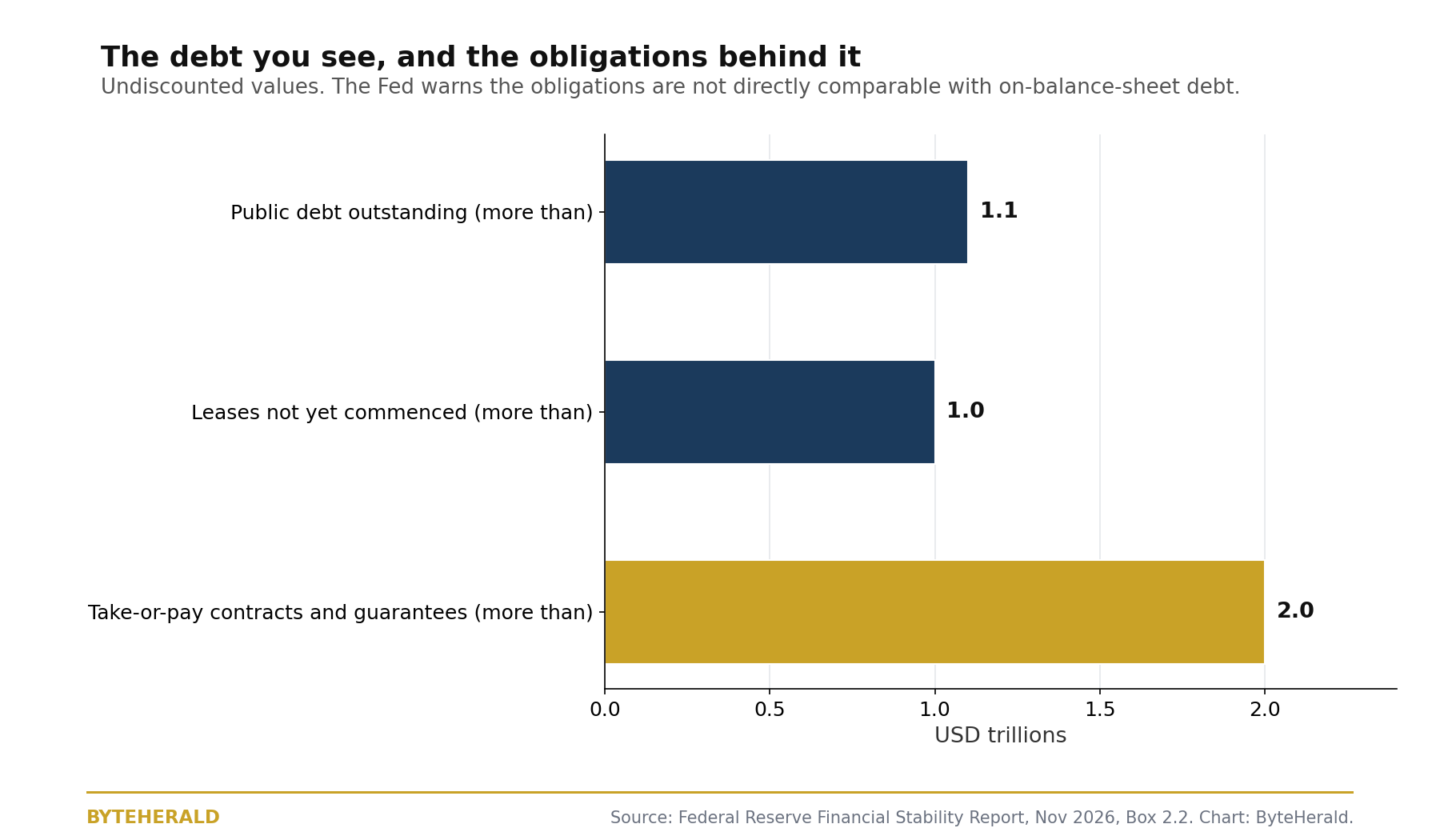
Box 2.2 of the same report, titled Leverage in the Data Center Buildout, puts the borrowing on the table. Advanced computing related debt issuance rose to more than 680 billion dollars by October 2026, about a fivefold increase from 130 billion dollars in all of 2023. Investment-grade technology companies issued most of this debt, and advanced computing related borrowing as a share of nonfinancial investment-grade corporate debt issuance increased from less than 6 percent in 2023 to about 31 percent in 2026. Outstanding public debt related to advanced computing is estimated at more than 1.1 trillion dollars as of October 2026. The composition is also changing: from mostly corporate bonds to a combination of public and private debt, structured credit, and project finance. The Fed defines the hyperscalers in this comparison as Amazon, Alphabet, Meta Platforms, Microsoft, and Oracle.
Then come the obligations that do not show up as debt. The report says not-yet-commenced leases, whose undiscounted values exceed 1 trillion dollars, and other obligations such as take-or-pay contracts and residual value guarantees, whose undiscounted values exceed 2 trillion dollars, have grown even more rapidly than the debt balances. Together that is more than 3 trillion dollars sitting behind the 1.1 trillion in public debt. The Fed adds a caveat the article keeps: these guarantees, lease obligations, and other contract commitments are generally not discounted and therefore are not directly comparable with on-balance-sheet debt, which is discounted. The analysis covers Amazon, Alphabet, Broadcom, Meta Platforms, Microsoft, Nvidia, and Oracle.
That 3 trillion dollar figure will look familiar to readers of our November 3 audit of the 3.2 trillion dollars in AI debt nobody put on a balance sheet, which added up the same kind of off-balance-sheet obligations from company filings. The Fed has now put its own number on the same pile, from the same filings, and reached the same scale. The two tallies are not identical: ours counted five companies' purchase commitments and leases, while the Fed's counts debt, leases, and guarantees across seven companies. The agreement on scale is the point.
| What the Fed counted | Figure | When |
|---|---|---|
| Advanced computing debt issued | More than 680 billion dollars | By October 2026 |
| Advanced computing debt issued | 130 billion dollars | All of 2023 |
| Share of nonfinancial investment-grade issuance | Less than 6 percent, rising to about 31 percent | 2023 to 2026 |
| Outstanding public debt, advanced computing | More than 1.1 trillion dollars | October 2026 |
| Leases not yet commenced, undiscounted | More than 1 trillion dollars | October 2026 |
| Take-or-pay contracts and guarantees, undiscounted | More than 2 trillion dollars | October 2026 |
The circular financing the Fed is watching
The report's most pointed passage is not a number. It is a mechanism. Long-term contracts, leases, and guarantees are ways in which hyperscalers and other large firms with strong credit ratings can support the financing of projects developed by weaker-credit firms without an immediate, direct effect on their own balance sheets. Hyperscaler firms often enter into long-term leases for data center capacity with third-party developers, and those leases are then used by the developers to secure financing for construction. Graphics processing unit makers often provide a guaranteed residual value of the GPU collateral to support purchases by advanced computing or large language model firms. These financings, the report says, are often supplemented with equity investments by the hyperscalers and GPU designers, which create a circular financing dynamic.
The Fed sees both sides of that circle. These connections mean the largest technology firms may absorb losses in a future downturn, mitigating the effects on the rest of the financial system. But it also suggests that these firms' economic exposure to such a downturn may be substantially larger than suggested by their on-balance-sheet liabilities. The on-balance-sheet debt is held primarily in mutual funds, pension funds, and insurance companies. A significant portion of the other obligations relate to financings that often involve special purpose entities that themselves issue both senior and subordinated debt, and the riskier subordinated debt and equity tranches are held by high-yield bond funds, life insurance companies, business development companies, and other private debt vehicles. The largest United States bank holding companies have close to 1 trillion dollars of exposure to large technology firms, data center developers, advanced computing related special purpose entities and private credit vehicles, and utility companies, and those exposures are evaluated during the annual supervisory stress test.
Faster than the telecom boom
The report draws the comparison the industry has been arguing about all year, and it does so with a chart, not a slogan. Figure B compares five hyperscaler firms' cumulative capital spending and debt issuance since 2020 with those of all firms in the telecommunications industry during the broadband investment cycle that started in 1995. The lines have been tracking relatively closely, the report says, but advanced computing investment has been accelerating of late, suggesting that the pace of the current cycle's investment may surpass that of the 1990s telecom cycle relatively soon. The same box notes that the hyperscalers' strong cash flows have reduced their need to issue debt to support similar investment levels, at least until this year.
The spending side of the same buildout is in our October 30 capex ledger, which added up 803 to 828 billion dollars across five companies in one year. The Fed's comparison puts that spending on the same chart as the 1990s telecom boom, and the lines are converging. The report's own words on valuations are blunter than the survey: measures of equity valuations have remained high, partly driven by market enthusiasm for super intelligence. Hedge fund leverage reached the highest level since 2013 and continued to be concentrated in the largest funds.
What the Fed did not say
The survey is one box in a report that runs past 50 pages, and the box carries a warning the headlines skip. It summarizes what 23 respondents told the New York Fed's staff, and it should not be read as the view of the Fed's Board or the New York Fed. The report's overall assessment is that the banking system remained sound and resilient, with high regulatory capital ratios, and that most domestic banks maintained high levels of liquid assets. The report reflects information available as of October 28, 2026, and the survey ran in September and October, which means respondents weighed in before the Nvidia leadership turmoil of November 12, as Reuters noted. None of this is a forecast of a correction. It is a survey of what 23 people who watch the system for a living are worried about, and for the first time the answer at the top of the list is AI. That distinction is the whole story: the Fed is not predicting a crash. It is reporting that the people it asks now rank AI above every traditional threat, and that the debt behind the buildout is growing faster than the balance sheets that carry it.
What to watch next
Four things will show whether this worry keeps rising. First, the next Financial Stability Report in about six months, and whether AI concern keeps climbing or starts to ease. Second, whether earnings keep pace with the valuations the survey calls stretched, since the correction scenario the respondents describe starts with earnings disappointing. Third, whether the circular financing the Fed describes unwinds or deepens as the buildout continues, since the report's own logic says the largest firms' true exposure is bigger than their balance sheets show. And fourth, what the annual stress test says about the banks' close to 1 trillion dollars of exposure to the technology, data center, and private credit complex, since that is where a bad AI quarter would land first.
By ByteHerald Staff. The Federal Reserve Board's Financial Stability Report, November 2026, released November 13, 2026, with data as of October 28, 2026, says in Box 5.1 that its survey of 23 market contacts in September and October put artificial intelligence at the top of the cited risks, with respondents naming elevated equity valuations, cybersecurity risk from state actors or frontier AI models, and complex forms of AI-related financing, and says in Box 2.2 that advanced computing related debt issuance rose to more than 680 billion dollars by October 2026, about five times the 130 billion dollars issued in all of 2023, with outstanding public debt of more than 1.1 trillion dollars and other obligations of more than 3 trillion dollars, and says in Section 1 that equity valuations have remained high, partly driven by market enthusiasm for super intelligence, and that hedge fund leverage reached its highest level since 2013. Reuters reported on November 13, 2026, that 87 percent of the contacts surveyed cited AI, up from 50 percent in the May survey, and that the next most cited risks were a correction in risk assets at 52 percent and higher long-term rates at 48 percent.
Comments
Post a Comment