Brave started selling search by the call on November 12, 2026. No account, no API key, no subscription. An agent sends a request, the server answers with HTTP 402 Payment Required and a price, the agent signs a stablecoin payment for that exact amount, and the search runs. The protocol is x402, and Brave is the first major independent search provider to sell on it, a characterization one independent probe used when it read Brave's invoice. We sent unpaid requests to two x402 sellers and read the invoices they returned. This is the price list, the fee math, and the limits, measured on November 14, 2026.
What x402 is
HTTP has carried a 402 Payment Required status code since the early days of the web, and almost nothing ever used it. x402 revives it as a payment protocol. A server that wants to charge for an API call answers an unpaid request with a 402 and a machine-readable invoice: the price, the network, the token, the address to pay, and how long the offer lasts. The client signs a payment for that amount and retries the request with the signed payment attached. A facilitator verifies the signature and settles the payment on the blockchain. The signed payment is the credential, so there is no API key to store, rotate, or leak, and no account to create before the first call.
The protocol itself is free. The x402 Foundation, which governs the standard under the Linux Foundation, describes it as an open, neutral standard for internet-native payments, with zero protocol fees: the customer and the merchant pay only nominal network fees. Coinbase introduced x402 in May 2025. The foundation's member list stood at 57 organizations as of October 19, 2026, including Coinbase, Cloudflare, Stripe, Google, AWS, PayPal, Visa, Mastercard, and American Express, with the technical steering committee seats held by Coinbase, Cloudflare, Stripe, Google, AWS, PayPal, Visa, Mastercard, and American Express. Membership is not the same as selling: Visa, Mastercard, and American Express help govern the standard, but none of them sells an x402 endpoint. The companies that actually move the money are the facilitators, the clouds, the wallets, and the sellers, and the table below is the first compiled list of what the sellers charge. We mapped the whole agentic commerce stack in October, five layers from the cart to the card network, with x402 as one row inside it: When Your AI Agent Buys Something, Who Gets Paid? priced the stack, and the prices below price the rail.
The price list
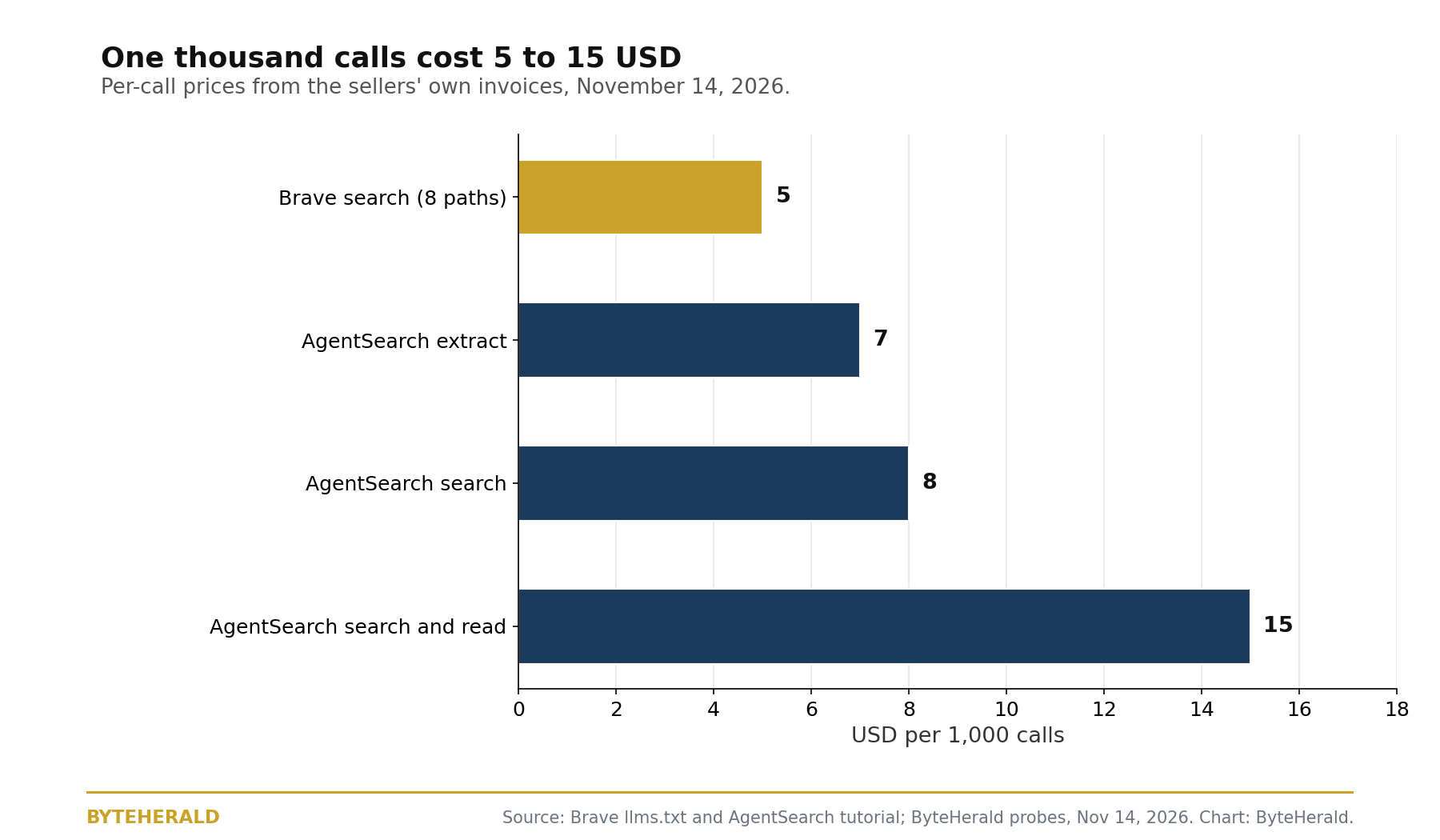
Two sellers publish per-call prices on x402 today, and both settle in USDC on the Base blockchain. Brave's announcement puts its eight search paths at the same price, and AgentSearch's own tutorial lists search, extraction, and a combined search-and-read call at three different prices. The facilitator that settles the payment charges its own fee, which is the number that decides whether a micropayment is worth collecting at all.
| Seller | What it sells | Price per call | Chain and token | Facilitator | Settlement rule |
|---|---|---|---|---|---|
| Brave Search API | Web search, LLM Context, news, video, image, place search, POIs, descriptions (8 paths) | 0.005 USD | Base, USDC | Brave runs its own | Pay per request; receipt on Base; gas covered for a limited time |
| AgentSearch | Web search (up to 10 results) | 0.008 USD | Base, USDC | Coinbase CDP (pays the gas) | Settled only after a successful answer; empty or failed calls never charged |
| AgentSearch | Page extract to clean markdown | 0.007 USD | Base, USDC | Coinbase CDP (pays the gas) | Settled only after a non-empty answer |
| AgentSearch | Search and read (top pages with markdown, one call) | 0.015 USD | Base, USDC | Coinbase CDP (pays the gas) | Settled only when at least one page has text |
| Coinbase CDP facilitator | Payment verification and settlement | Free for the first 1,000 transactions a month, then 0.001 USD per transaction | Base, Polygon, Arbitrum, Monad, World, Solana | Coinbase CDP | Per-transaction fee after the free tier |
At these prices, one USDC buys 200 Brave searches, 125 AgentSearch searches, or about 140 AgentSearch extracts. A typical agent run of one search and two page reads costs 0.022 USD on AgentSearch, or a single 0.015 USD call if the search and the reads are bundled. The prices are dated November 14, 2026, and the 402 response is the authoritative price of each exact request, so a seller can change a price without changing its documentation.
We read the invoices
An unpaid request costs nothing, and the invoice it returns is the most honest document in this market, because the server has to state its terms before it can be paid. We sent one unpaid request to each seller and decoded the payment-required header each returned. No payment was sent in either probe, so the pay-then-retry loop was not completed end to end, and this article does not claim it was.
Brave's invoice, for a web search, arrived with an HTTP 402 Payment Required with an empty body, zero bytes. The header decoded to x402 version 2, scheme "exact", network eip155:8453, which is Base, amount 5000 base units of a six-decimal token, which is 0.005 USD, asset 0x833589fCD6eDb6E08f4c7C32D4f71b54bdA02913, which is the canonical USDC contract on Base, payee 0xFFa76529d7e733C671190b374819d8e2A02b9D04, a 300-second expiry, and the transfer method EIP-3009, a signed transfer authorization, so the agent signs but never broadcasts its own transaction. Exactly one payment option was offered: one chain, one token, one price, no negotiation. Brave's own machine-readable price list, at llms.txt on the same proxy, lists the same eight paths at the same 5000 base units, and its documentation says the 402 is the authoritative price, which our probe confirmed.
AgentSearch's invoice, for a search, decoded to the same shape with different numbers: x402 version 2, scheme "exact", network eip155:8453, amount 8000 base units, which is 0.008 USD, the same USDC contract, payee 0x49B157887e51c21CB655F39CF6506a4c2a4C337, a 300-second expiry, and the service name "Web Search API | AgentSearch". The payee address matches the one in AgentSearch's own tutorial, which is a useful check: before trusting a payee, check it against the seller's own published address. Two independent probes of Brave's invoice, published by developers on November 12 and 13, 2026, decoded the same 5000 base units, the same chain, and the same transfer method: one read the 402 byte for byte on November 12, and another read the invoice on November 13, and the first of the two called Brave the first major independent search provider to sell per call on the protocol. The one difference between the two sellers is the body: Brave's 402 body was empty, while AgentSearch's carried 3,775 bytes, so this article does not claim an empty body for AgentSearch.
The settlement fee is the floor
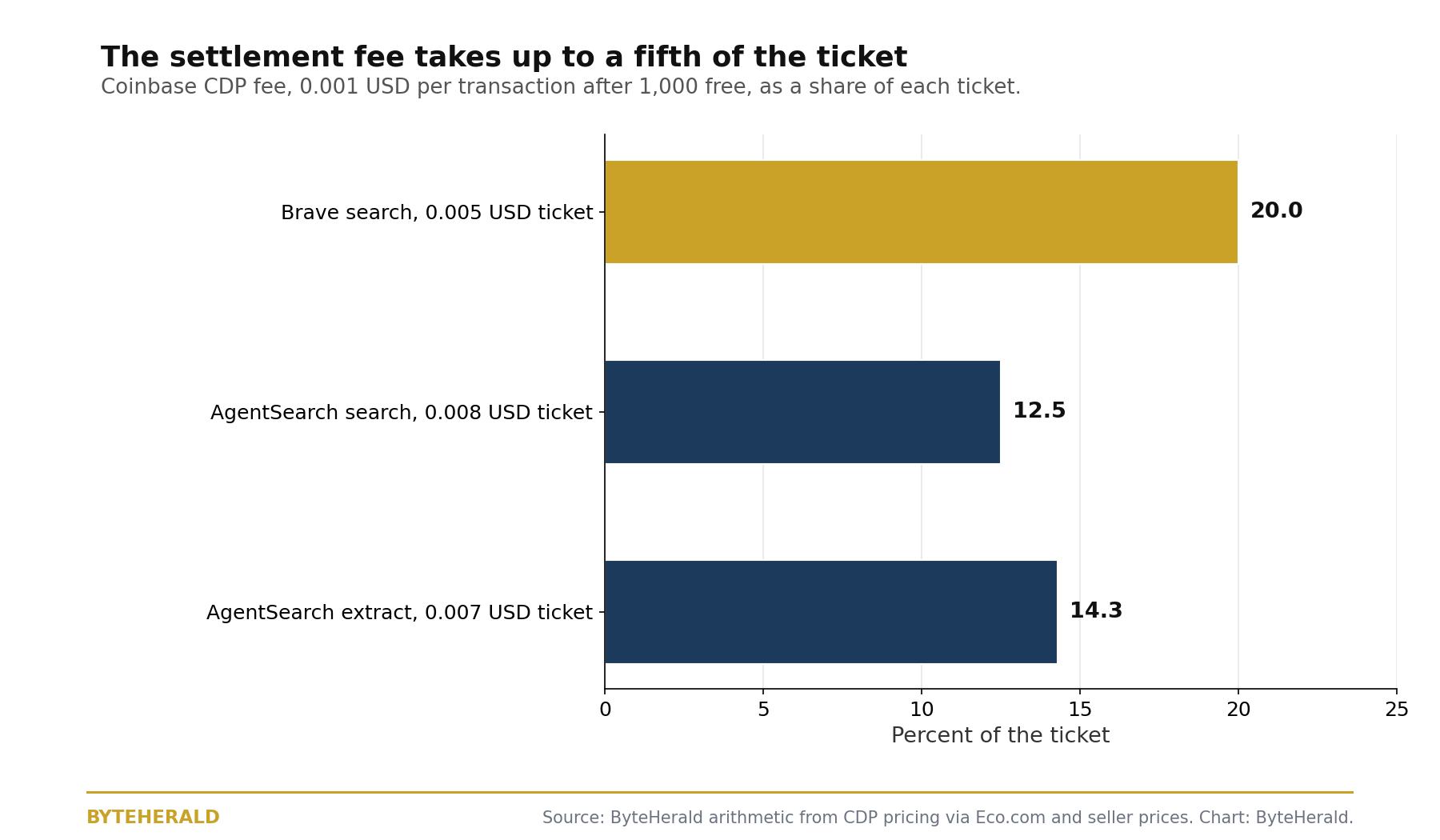
The most important number in the table is not a seller's price. It is the facilitator's fee, because it sets the floor below which a micropayment cannot work. Coinbase's CDP facilitator, the most used one, is free for the first 1,000 transactions a month and charges 0.001 USD per transaction beyond that, according to Eco.com's reading of the CDP documentation. On Brave's 0.005 USD ticket, that fee is 20 percent of the price. On AgentSearch's 0.008 USD search, it is 12.5 percent. On the 0.007 USD extract, it is 14.3 percent. A seller that charges less than a tenth of a cent per call would hand the entire price, and more, to the facilitator.
Brave's own price list proves the point, because it publishes the calls it will not sell. Its Answers API is not sold on x402, since it bills per query and per token, which one fixed price cannot express. Autosuggest and Spellcheck are not sold either, and Brave says why in its own documentation: they cost less than the fee a facilitator takes for settling one payment, so they wait on settling many queries together as one payment. The Summarizer is not sold because Brave has deprecated it. A path outside the eight in the table is a 404, never a payable 402, and a payment is checked against the price of the path it is sent to, so a payer cannot name its own price. The rule that falls out of this is simple: x402 works for calls priced above the settlement fee, and the sub-cent calls it was supposed to unlock are exactly the ones that still need batched settlement to exist.
That is also why Brave's gas promise matters and why it should be read carefully. Brave says gas fees for transacting on Base will be covered for a limited time. Neither this article's probes nor the two independent probes published on November 12 and 13 completed a purchase, so nobody outside Brave has verified end to end that the gas is covered, or for how long "a limited time" lasts. The claim is Brave's, and it is recorded here as Brave's.
Who else sells on x402, and who does not
Brave and AgentSearch are the two sellers with published per-call prices we could verify from a live invoice. The rest of the market is wider but less transparent. The official documentation lists 15 production facilitators, including Coinbase CDP, PayAI, Corbits, Dexter, Fireblocks, Polygon, Celo, and the Stellar and NEAR facilitators, and Coinbase's CDP facilitator alone reports more than 100 million transactions on Base and Solana. PayAI lists eight mainnets; Circle's facilitator service settles USDC on Arc, Base, and Polygon PoS. By April 2026, five named deployments were running in production: Coinbase's Agent market directory, Stripe's machine payments, CoinGecko's paid endpoints, Circle Wallets' reference workflow, and the Cloudflare Agents SDK. The x402.org counter, as read in an October 19, 2026 ecosystem map, showed about 94,000 buyers and, in a separate figure, about 22,000 sellers, which says the buyers arrived before the sellers did.
The comparison that matters most for a buyer is not between two x402 sellers but between x402 and the card rails. OpenAI's ChatGPT Wallet, launched the same week Brave went live on x402, takes the opposite approach: tokenized cards, no commission at launch, and a security check before every purchase, with the agent never seeing the real card number. We covered that launch and the fight over whether stores will let agents buy at all in ChatGPT Wallet Lets Agents Pay. Not Every Store Agrees. Google's Agent Payments Protocol, known as AP2, has an x402 extension, and the competing protocols named in the trade press are Stripe and OpenAI's Agentic Commerce Protocol and Visa's Trusted Agent Protocol. None of those publishes a per-call price, so this article does not invent one for them. The honest summary is that x402 is the cheapest rail to quote, because its prices are public and per call, and the card rails are the cheapest rail to use, because the buyer already has a card. Which one wins depends on whether the seller wants a price list or a checkout form.
That distinction is also where the October picture fits. The permission question from our stack has not gone away: an agent that can pay still has to be allowed to buy, and the stores that block agents, mapped in our map of who blocks AI agents, do not care which rail the payment arrives on.
Five tests for the rail
The rail passes or fails on five tests. First, Brave's promised support for other networks and stablecoins, which would break the current one-chain, one-token shape. Second, batched settlement for sub-cent queries, which is the only way Autosuggest and Spellcheck ever get sold, and which Brave says is coming. Third, whether a second major search provider joins, since one seller is a feature and two sellers are a market. Fourth, whether the facilitator fee falls below 0.001 USD as volume grows, since the fee is the floor and the floor decides which calls can exist. And fifth, whether the 57-member foundation ships a version 3 of the protocol that changes the invoice format, since every client that parses the payment-required header, including ours, depends on the shape staying stable.
By ByteHerald Staff. Brave announced on November 12, 2026, that its Search API accepts agentic payments via the x402 protocol, that it runs its own facilitator accepting USDC on the Base blockchain, and that LLM Context and web, news, image, video, and local endpoints cost 0.005 USD per request, with gas fees covered for a limited time. Brave's Search API documentation states that the x402 proxy at search.agent.s.brave.app serves the API without an API key or an account, that the signed payment is the credential, and that Answers, Autosuggest, and Spellcheck are not sold there yet. ByteHerald probed Brave's proxy on November 14, 2026, sending an unpaid request that returned an empty body and a payment-required header decoding to x402 version 2, network eip155:8453, amount 5000 base units, asset 0x833589fCD6eDb6E08f4c7C32D4f71b54bdA02913, payee 0xFFa76529d7e733C671190b374819d8e2A02b9D04, a 300-second expiry, and transfer method EIP-3009, with no payment sent. AgentSearch's tutorial, published on November 10, 2026, lists search at 0.008 USD per call, extract at 0.007 USD, and search and read at 0.015 USD, settling in USDC on Base through the Coinbase CDP facilitator, with payment settled only after a successful answer. ByteHerald probed AgentSearch's API on November 14, 2026, sending an unpaid request that returned a 402 with a payment-required header decoding to x402 version 2, network eip155:8453, amount 8000 base units, the same USDC contract, and payee 0x49B157887e51c21CB655F39CF6506a4c2a4C337, with no payment sent. Two developers published independent probes of Brave's invoice on November 12 and 13, 2026, each decoding the same 5000 base units, the same chain, and the same transfer method, and the first called Brave the first major independent search provider to sell per call on the protocol. The x402 Foundation's site describes x402 as an open, neutral standard for internet-native payments with zero protocol fees. Payzum's ecosystem map of October 19, 2026, lists 57 foundation members, 15 production facilitators, and about 94,000 buyers against 22,000 sellers. Eco.com reported that Coinbase released x402 on May 6, 2025, and that the CDP facilitator is free for the first 1,000 transactions a month and charges 0.001 USD per transaction beyond that.
Comments
Post a Comment