The United States closed the rent-a-chip loophole on November 16, 2026, with a Commerce Department interim rule that requires a license to send AI chips and servers to any data center in the world if it may rent computing power to companies in China or other restricted countries, according to TechCrunch. For four years, Washington banned selling its best AI chips to China, while Chinese companies could legally rent time on those same chips in data centers abroad. The new rule treats the rental the same as the sale, once the computing power crosses a line the rule sets at 12 million total processing performance, roughly the power of 750 Nvidia H100 or H200 chips.
What the rule does
The rule, an interim final rule from the Commerce Department's Bureau of Industry and Security, does four things at once. It is identified as RIN 0694-AK50 and runs 132 pages.
| Part of the rule | What changes | Who it hits |
| Data center end-use control | A license is required to export, reexport or transfer AI chips and servers to a data center anywhere in the world if it may provide over 12 million aggregate TPP of compute to companies in China, Macau or other D:5 countries | Chip exporters and data center operators worldwide |
| Five-country licensing | New license requirements for advanced chip exports to Malaysia, Singapore, Indonesia, Thailand and Brazil, cited as a higher-than-normal risk of diversion | Chip shipments to those five countries, except chips destined for US-based companies |
| Brokers and go-betweens | Indirect access through intermediaries is covered; operators must watch customers' ownership structures and activities | Anyone renting compute through a middleman |
| Diffusion Rule rescinded | The Biden administration's January 2025 AI Diffusion Rule is formally rescinded; it was never enforced | The country-tier system it would have imposed |
The rule was written at the direction of the Treasury Department and the National Security Council, according to the Bureau of Industry and Security, "to ensure that existing restrictions on access to sensitive American technology cannot be circumvented through remote computing arrangements involving data centers in third countries." License applications under the data center control will be reviewed case by case. The rule takes effect when it is published in the Federal Register, which has not happened yet, and comments are due 60 days after publication.
The 12 million TPP line
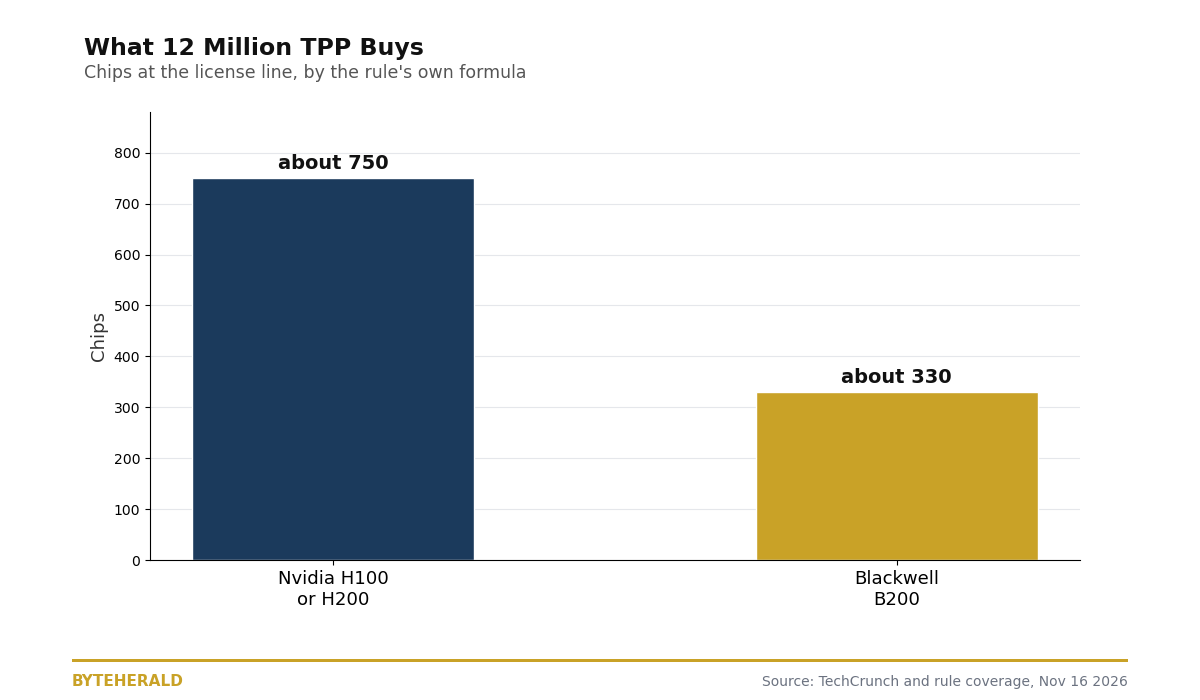
Total processing performance, or TPP, is the export-control metric the United States uses to measure computing power. The threshold counts aggregate TPP across a data center's covered chips, and it can be reached across linked data centers, not only at one site. By the rule's formula and Nvidia's published figures, 12 million TPP works out to roughly 750 H100 or H200 chips, about 330 Blackwell B200 chips, or just over four GB200 NVL72 racks. That is a small data center by hyperscaler standards and a large one by any other measure, which is the point: the line is low enough to catch commercial rental operations and high enough to leave ordinary cloud use alone.
The control applies when an exporter knows the chips will provide that level of compute to a company headquartered in Macau or a Country Group D:5 destination, or whose ultimate parent is headquartered there. The D:5 group is the United States' list of embargoed countries, and it includes China, Russia, Iran and North Korea plus 18 others. Existing data center operators already providing covered services must get licenses within 90 days of the rule coming into effect, or face further export restrictions. The one carve-out is compute used only for commercial recommendation systems, the kind online shops and social networks use to rank products and posts. Anything that generates text, images, audio, video or code does not count as a recommendation system under the rule.
How this differs from the proposal
The rule lands one day after the New York Times reported that Commerce Secretary Howard Lutnick has been pushing a narrower version of the chip rules, one that would cover seven countries, exempt existing data centers, and require notification rather than a license when Chinese customers train AI models. Our November 15 report covered that investigation in full, including the overlap with Cantor Fitzgerald, the firm Lutnick ran for decades and his sons now run. The interim rule is broader than Lutnick's proposal in reach and narrower in its country list: it sets a global license requirement for remote access, while the new licensing requirement for chip shipments covers five of the seven countries in the proposal, Malaysia, Singapore, Indonesia, Thailand and Brazil, and leaves out South Africa and Norway.
It is also distinct from the legislation moving through Congress. Four bills in the defense bill would rewrite AI chip exports, from licenses to chip tracking to rental blocks, but those are proposals in a bill that has not passed. This rule is already written. It is an executive action, not a vote, and it takes effect on publication. The bills would add to it; they do not need to pass for it to bite.
Why now
The rule comes days after Jensen Huang resigned as Nvidia's chief executive amid a scandal involving an alleged Chinese spy linked to one of the chipmaker's customers. The United States government has reportedly been wanting to put that customer, Megaspeed, on a special entity list, because it believes the company has been buying thousands of Nvidia chips to provide compute to Chinese businesses and get past existing export controls. Reuters reported last week that Chinese AI companies are rushing to secure computing capacity overseas amid fears of tighter restrictions. The rule is written for exactly that rush.
The timing also matters for the calendar. Existing operators have 90 days from the effective date to get licenses, which means the first real test of the rule comes in early 2027, when operators must either show their licenses or stop serving restricted customers. The comment period runs 60 days after Federal Register publication, so the rule can still change, but as an interim final rule it is effective on publication, not after the comments close. Companies that built their business on renting American chips to Chinese customers from a third country now have a deadline, a threshold, and a license application to file.
How the rental loophole worked
American law controls where a chip is sold, not where its computing power is rented. A Chinese company cannot buy Nvidia's most advanced chips, but it can rent time on them in a data center in Malaysia, and the data center's operator can buy the chips legally because the operator is not in China. Our map of every AI export control shows the controls as written, and the rental route is the gap the controls never covered. The new rule closes it by making the rental a licensed activity too, once the computing power crosses 12 million TPP. Below that line, nothing changes. Above it, the operator needs a license, and the license can be denied.
By ByteHerald Staff. TechCrunch reported on November 16, 2026, that the Trump administration is rolling out new export controls on AI chips and data centers outside the United States, that the Commerce Department will require licenses to export, reexport or transfer AI chips and servers to data centers anywhere in the world if they may provide compute to companies in China or other restricted countries, that the rule applies above 12 million total processing performance, roughly the power of about 750 Nvidia H100 or H200 chips, that it adds licensing for chip exports to Malaysia, Singapore, Indonesia, Thailand and Brazil, that existing operators must get licenses within 90 days, and that it rescinds the Biden administration's AI Diffusion Rule from January 2025. Unite.AI reported on November 16, 2026, that the Bureau of Industry and Security released the interim final rule on November 16, 2026, that license applications will be reviewed case by case, that the threshold can be reached across linked data centers, and that the rule takes effect on Federal Register publication with comments due 60 days later. ZeroHedge reported on November 16, 2026, that the 132-page rule, RIN 0694-AK50, sets the threshold at roughly 760 H100s (other outlets calculate about 750), about 330 B200s, or just over four GB200 NVL72 racks.
Comments
Post a Comment