Thinking Machines Lab launched Inkling 2 Small on November 5, 2026, and the numbers split cleanly in two. On hard coding and enterprise work it is near the frontier: 86.3 percent on SWE-Bench Pro v2 Hard, second only to Kimi K3, and 71.8 percent on EnterpriseBench-CoreCraft, third overall behind two Claude models. On terminal work it falls apart, scoring 13.1 percent on Terminal-Bench 4.0, less than half the score of the cheapest Chinese rivals. The model costs 30 cents per million input tokens and 1 dollar per million output tokens on the company's Tinker platform, and its weights are not open yet, despite the open-weights promise in the launch. The audit below takes the company's own benchmark table at its word, including the rows that embarrass it.
The numbers that matter
Inkling 2 Small is a mixture-of-experts model with 594 billion total parameters and 17 billion active for each token, which means most of the model sits idle on any given token while a small slice does the work. It accepts text and image inputs, runs at variable effort, and was trained with reinforcement learning on hundreds of thousands of long-horizon coding tasks. On the Artificial Analysis Intelligence Index it scores 31, or 30.6 on version 5.0 of the index, against 13 for its predecessor Inkling Small. Thinking Machines says it is the highest benchmarked model the lab has released, and that when the weights are released it will be the top open model not from China, ahead of Mistral Large 4 at 26. The table below is the company's own release table, which mixes named third-party benchmarks with reported evaluations, and every score in it should be read as the lab's claim, not an independent test.
| Benchmark | Inkling 2 Small | Best rival in the table |
|---|---|---|
| Artificial Analysis Intelligence Index | 31 | DeepSeek-V4.1-Flash-1017, 32.6 |
| SWE-Bench Pro v2 (Hard) | 86.3% | Kimi K3, 88.2% |
| EnterpriseBench-CoreCraft | 71.8% | Claude Fable 5.1, 77.4% |
| JobBench | 70.5% | Inkling 2 Small leads the row |
| DeepSWE v1.1 | 72.1% | DeepSeek-V4.1-Flash-1017, 77.0% |
| AA-Briefcase v1.1 (ELO) | 1527 | DeepSeek-V4.1-Flash-1017, 1570 |
| Vals Legal Index | 73.9% | Inkling 2 Small leads the row |
| Terminal-Bench 4.0 | 13.1% | DeepSeek-V4.1-Flash-1017, 33.8% |
| DAYJOB (finance tasks) | 14.3% | Not published in the coverage verified |
Where it wins: code, enterprise work, and price
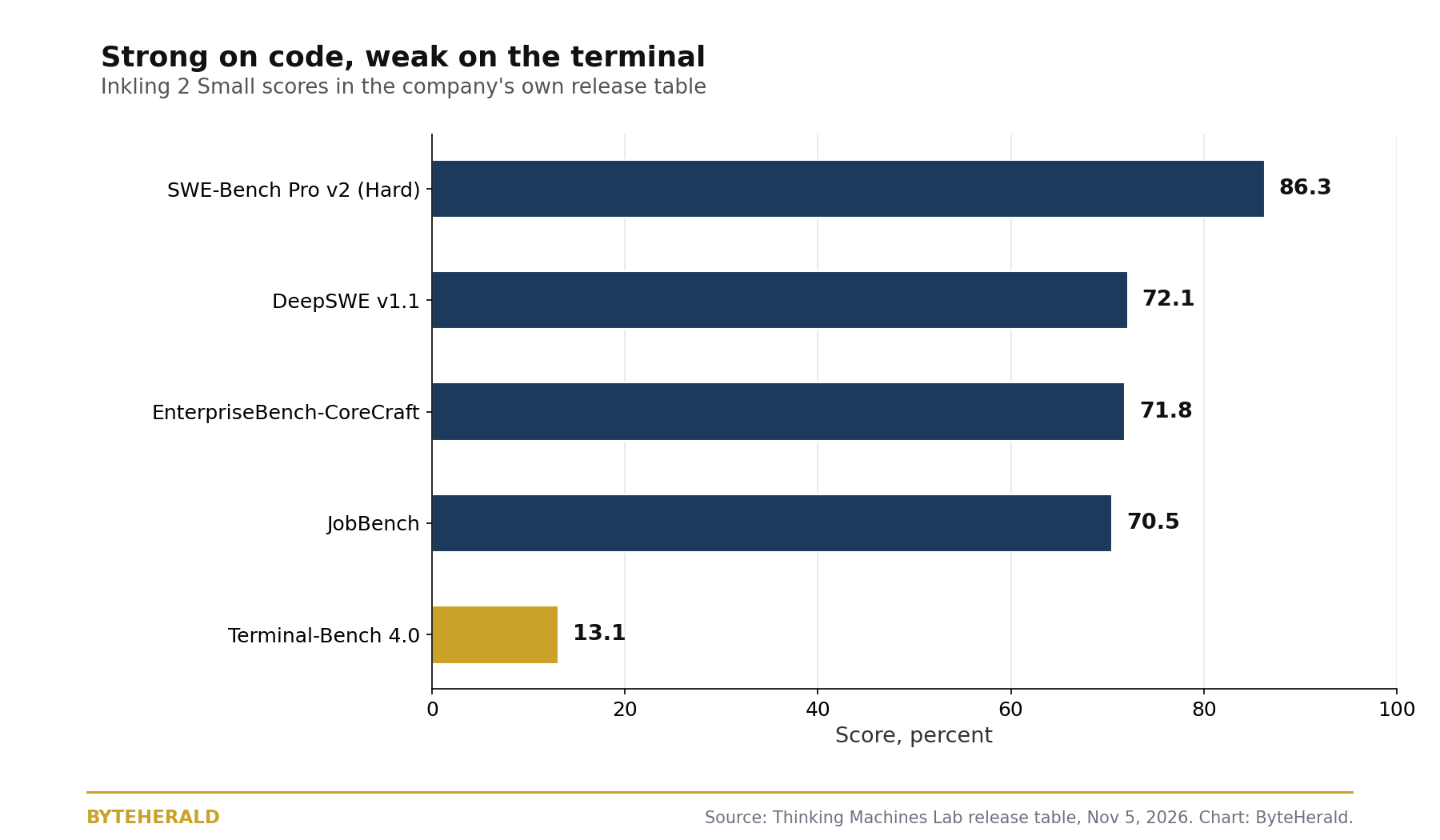
The strongest rows are the ones enterprises actually buy for. SWE-Bench Pro v2 Hard is Scale AI's test bed of real-world software problems, and 86.3 percent puts Inkling 2 Small second in the lab's table, behind only Kimi K3 at 88.2 percent. EnterpriseBench-CoreCraft, from Surge AI, measures agentic performance across a fictional PC parts supplier including simulated dissatisfied customers, and 71.8 percent is third overall, behind Claude Fable 5.1 at 77.4 percent and Claude Opus 5.5 at 74.4 percent, and well ahead of GLM-5.3-Flash at 46.7 percent. JobBench, at 70.5 percent, leads the row outright against Muse Spark Open at 61.8 percent and Mistral Large 4 at 55.2 percent. The Vals Legal Index, at 73.9 percent, also leads its row. On knowledge work the picture holds: AA-Briefcase v1.1 gives it an ELO of 1527, second-highest reported, behind DeepSeek-V4.1-Flash-1017 at 1570, and GDPVal-AA v2.1 gives it 1630 against 1746 for DeepSeek and 1649 for GLM-5.3-Flash. DesignArena, the pairwise vote on generated websites, puts it third with 1,340 points on the November 5 snapshot. On PMPP-Hard, an external GPU kernel optimization benchmark of 69 tasks with a 10-hour budget, it solved 54.25 tasks on average. The price is the other half of the win. At 30 cents per million input tokens and 1 dollar per million output tokens on Tinker, it undercuts the closed frontier on input cost while posting scores within a few points of models that cost far more to run. The Artificial Analysis index that gives Inkling its 31 is the same scoreboard we tracked in the Intelligence Index v5 update on November 3, where the index itself, not any single model, is the story.
Where it loses: the terminal
Terminal-Bench 4.0 is the hole in the table, and the lab published it anyway. Inkling 2 Small scores 13.1 percent on command-line tasks, against 33.8 percent for DeepSeek-V4.1-Flash-1017 and 32.8 percent for GLM-5.3-Flash. Only Kimi K3 scores lower in the row, at 12.6 percent. The gap matters because the terminal is where an agentic coding model actually works: installing packages, running tests, reading logs, and recovering from its own errors. A model that writes code at 86 percent and operates a terminal at 13 percent is a strong pair programmer and a weak autonomous engineer, and buyers who need the second job should weight the terminal number more heavily than the coding number. Our computer-use scoreboard from November 5 shows the same split across the field: models that lead on GUI and terminal benchmarks are not always the ones that lead on code generation, and the gap between the two is where deployments quietly fail. The finance tasks are the other weak spot. DAYJOB, a finance and document benchmark in the same table, comes in at 14.3 percent, which the coverage notes as low in absolute terms. Outputs on finance and document tasks need checking, whatever the headline scores say.
Open weights, next week, not today
The launch comes with a promise that is easy to misread. Inkling 2 Small is available now on Tinker for inference and fine-tuning, and in the Tinker Playground for sampling, but the weights are closed at launch. Thinking Machines says it will release the full weights under an Apache 2.0 license next week, after external safety testing and red-teaming, following what it calls a safe path to open weights. VentureBeat, covering the launch on November 6, reports the weights remain closed at launch pending external safety evaluations, with release targeted for the week following the announcement. Until the weights land, the model cannot be self-hosted, and the claim that it will be the top open model not from China is a claim about a future release, not a model anyone can download today. The open-weight benchmark wars we tracked in October show why the timing matters: Mistral Large 4, Muse Spark Open, and the Chinese open models are downloadable now, and a week is a long time in a race where the leaderboard moves every few days. The weights, when they arrive, will support MXFP8 and NVFP4 formats. The honest summary is that Thinking Machines shipped a strong, cheap, near-frontier model with one documented weakness and one unfulfilled promise, and both facts belong in the same sentence.
By ByteHerald Staff. Thinking Machines Lab introduced Inkling 2 Small on November 5, 2026, reporting a score of 31 on the Artificial Analysis Intelligence Index, 86.3 percent on SWE-Bench Pro v2 Hard, 71.8 percent on EnterpriseBench-CoreCraft, and 13.1 percent on Terminal-Bench 4.0, with pricing of 30 cents per million input tokens and 1 dollar per million output tokens on Tinker, and weights to be released under Apache 2.0 after external safety testing. VentureBeat covered the launch on November 6, 2026, confirming the index score, the price, and the weights timing. Artificial Analysis publishes the Intelligence Index the lab cites, and Surge AI publishes the EnterpriseBench-CoreCraft benchmark in which Inkling 2 Small scored 71.8 percent.
Comments
Post a Comment