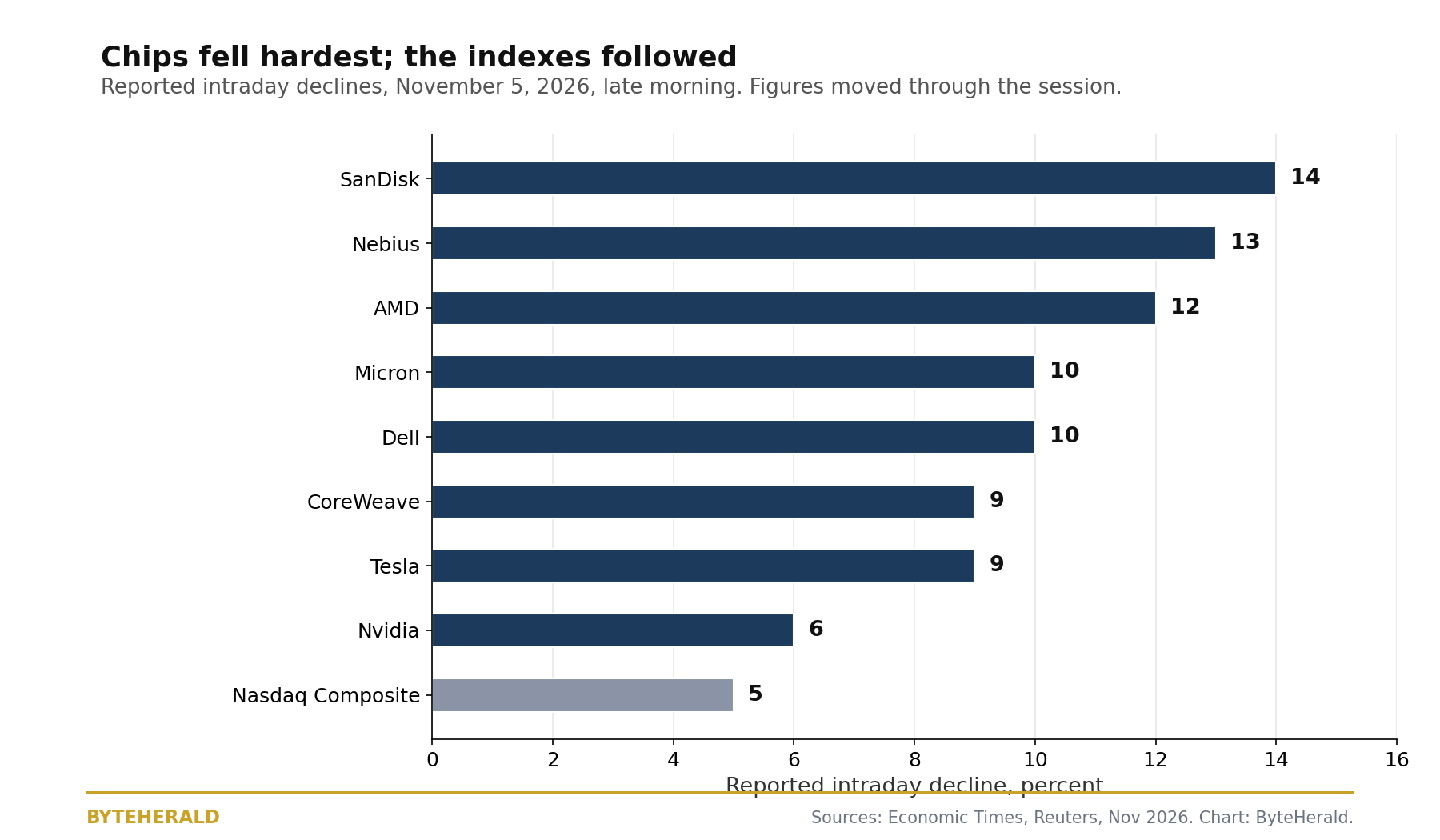
Wall Street gave the AI trade one day to celebrate, then took it back. The Dow Jones Industrial Average jumped 1,569 points on Wednesday, November 4, 2026, after Democrats swept Congress in the midterm elections. On Thursday, November 5, the Nasdaq Composite fell as much as 5 percent intraday, the Philadelphia Semiconductor Index fell as much as 11 percent, and the Nasdaq crossed into correction territory intraday, more than 10 percent below its record close of October 6. Chip stocks led the fall, neocloud operators and AI server makers followed, and about 2 trillion dollars in chip market value disappeared in a single session, according to Yahoo Finance. The figures below are intraday snapshots reported late Thursday morning, and they moved through the session; the close may differ.
The scoreboard: chips fell hardest
The damage was concentrated exactly where the AI trade lives. Advanced Micro Devices fell about 12 percent, SanDisk about 14 percent, Micron about 10 percent in the late-morning snapshot and nearly 14 percent by midday, Dell about 10 percent in the morning snapshot and nearly 13 percent by midday, and Nvidia about 6 percent in the morning snapshot and 8.2 percent by midday, according to the Economic Times and Al Jazeera. The neocloud names fell harder: CoreWeave dropped about 9 percent in the morning snapshot and more than 12 percent by midday, and Nebius fell about 13 percent in the morning snapshot and nearly 17 percent by midday. Tesla fell about 9 percent in the morning snapshot and more than 11 percent by midday, Palantir about 8 percent, and Meta about 3 to 3.8 percent. The indexes followed the stocks down: the Nasdaq Composite fell as much as 5 percent intraday and stood down nearly 4 percent at 24,712.60 on Thursday morning, the S&P 500 fell about 3.4 percent, and the Dow fell about 2.6 percent, down more than 1,300 points. The S&P 500 was on course for its worst day since the April 2025 tariff selloff, according to the Associated Press.
| Stock or index | Reported intraday decline, late morning Nov 5 | Later in the session |
|---|---|---|
| SanDisk | about 14% | about 20% at one point, per market quotes |
| Nebius | about 13% | nearly 17% by midday |
| AMD | about 12% | about 11 to 12% through the session |
| Micron | about 10% | nearly 14% by midday |
| Dell | about 10% | nearly 13% by midday |
| CoreWeave | about 9% | more than 12% by midday |
| Tesla | about 9% | more than 11% by midday |
| Nvidia | about 6% | 8.2% by midday |
| Nasdaq Composite | as much as 5% | down nearly 4% at 24,712.60 Thursday morning |
| S&P 500 | about 3.4% | about 3.4 to 3.6% through the session |
Why it happened on Thursday
No single trigger explains the reversal, according to one report cited by the Associated Press, but three pressures converged. First, the election itself: investors weighed whether a Democratic Congress would slow the buildout of AI data centers, and Tuesday's elections also passed dozens of ballot initiatives that stand to limit building in coming months and years, Reuters reported. Second, the spending question: the market has spent the autumn asking how quickly hundreds of billions in data-center spending turns into profit, and Bloomberg noted that Alphabet and Amazon have posted negative free cash flow as debt rises, which fed the profit-taking. That is the same borrowing the market is now repricing, and the November financing ledger shows the instruments paying for the buildout, from Oracle's 20 billion dollars in stock and bonds to SpaceX's 40 billion dollar GPU lease. Third, a proximate chip trigger: Qualcomm fell as much as 13 percent after saying fourth-quarter smartphone chip sales fell short of expectations, citing weak demand and less business from Apple, and the chip selloff gathered pace from there. The Philadelphia Semiconductor Index fell as much as 11 percent, its worst performance since March 2020, Reuters reported, and it is down about 31 percent from its 52-week high, according to 50 Park Investments chief executive Adam Sarhan, who told Reuters that AI stocks are already in a private bear market that virtually nobody is talking about.
What the market is pricing
A one-day fall does not prove the AI trade is over, and this article makes no claim about where stocks go next. What it does show is the market repricing the obligations behind the trade. ByteHerald's own arithmetic, from the numbers above: the Nasdaq's record close on October 6, 2026, was 27,599.89, and Thursday morning's 24,712.60 is 10.5 percent below that high. A correction is a fall of 10 percent or more from a recent high, so the Nasdaq crossed 10 percent below its high on Thursday morning, and a close near those levels would confirm the correction. The context for the repricing is the stock of promises behind the spending: about 3.2 trillion dollars in off-balance-sheet AI obligations that five companies signed in the last six months, almost double the level of six months earlier, and the spending those obligations fund is the same spending investors now question. Not everything fell: Apple rose about 1 percent, AppLovin jumped 32 percent on a third-quarter profit beat, and Snap fell 12 percent after missing revenue estimates, which shows the market was discriminating between names rather than selling everything at once. The honest read is that Thursday repriced the AI buildout's financing risk, not that it settled whether the buildout pays.
What would change the story
Three things would falsify the bearish reading, and three would confirm it. On the bearish side, a close that holds the Nasdaq more than 10 percent below its October high confirms the correction; further cuts to data-center permits in the states that voted for limits would slow the buildout itself; and any hyperscaler cutting capital expenditure guidance would turn a financing worry into a demand worry. On the other side, a recovery in the chip index would show Thursday as a positioning flush rather than a repricing; strong fourth-quarter earnings from the chipmakers would put numbers against the doubt; and new data-center permits moving forward would show the ballot limits are narrower than feared. The last time ByteHerald ran this kind of one-day scoreboard, on October 29, four software stocks fell in a single session on the same thesis, that AI would eat their revenue before it paid for itself, and the question then was the same as now: whether the spending turns into profit fast enough to carry the debt. Thursday's answer was no, for one day, and the close will say whether the market meant it.
By ByteHerald Staff. Reuters, November 5, 2026, reported tech stocks headed for their worst decline since June, with the Philadelphia Semiconductor Index down as much as 11 percent, its worst since March 2020, the Nasdaq Composite down as much as 5 percent, and more than a dozen large technology stocks down double digits, and quoted 50 Park Investments saying the semiconductor index is down about 31 percent from its 52-week high. The Associated Press, November 5, 2026, reported the Nasdaq fell about 5 percent, the S&P 500 about 3.4 percent and the Dow roughly 2.6 percent, with the S&P 500 posting its worst day since the April 2025 tariff selloff, and Yahoo Finance reported roughly 2 trillion dollars in chip market value wiped out. Al Jazeera, November 5, 2026, reported midday losses including CoreWeave over 12 percent, Nebius nearly 17 percent, Nvidia 8.2 percent, Micron nearly 14 percent, Dell nearly 13 percent, and Tesla over 11 percent. The Economic Times, November 5, 2026, reported an 11:48 a.m. Eastern snapshot with the Dow down 2.36 percent, the S&P 500 down 3.11 percent, and the Nasdaq down 4.20 percent, with AMD down 12 percent, SanDisk 14 percent, Micron 10 percent, Dell 10 percent, and Nvidia 6 percent. Bloomberg, via Le Private Banker, November 5, 2026, reported the Dow rallied 1,569 points on November 4 after the Democratic sweep and the Nasdaq 100 fell as much as 5.7 percent on November 5.
Comments
Post a Comment